






What's Happening?
Daisy Pops, a home-based cake pop business founded in Kent, Ohio, by Amy Mucha in 2016, has evolved into a manufacturing operation through the strategic use of 3D printing. Initially, Mucha, a high school mathematics teacher, sold handcrafted cake pops
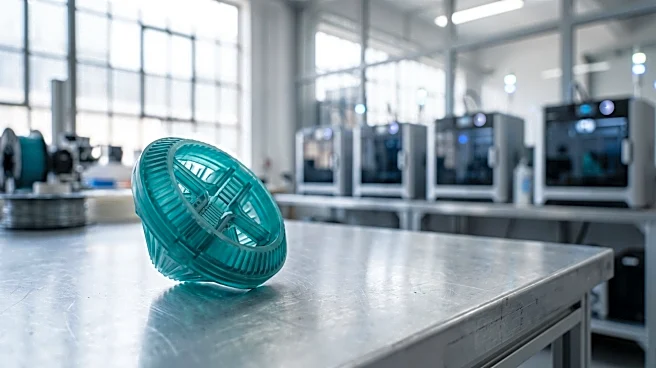
to her local community. By 2018, increased demand led her to establish Daisy Pops as a formal business. The company's customer base expanded nationwide by 2021, prompting Mucha to leave her teaching career to focus on entrepreneurship full-time. This growth led to the creation of Daisy Makes, a separate entity that manufactures specialized cake pop tools using 3D printing technology. The facility reportedly houses over 200 3D printers, demonstrating how desktop additive manufacturing can scale from a small-scale production method into a significant manufacturing operation. This case highlights how entrepreneurs can identify unmet product needs within their industries and develop in-house manufacturing capabilities to address them, particularly for niche markets that traditional manufacturers might overlook.
Why It's Important?
This development is significant as it showcases the transformative potential of additive manufacturing, specifically 3D printing, for small and home-based businesses in the U.S. It illustrates a pathway for entrepreneurs to transition from producing consumer goods to manufacturing specialized tools for their industry, a process known as vertical diversification. Unlike conventional manufacturing, which often demands substantial upfront investment in tooling and large minimum production volumes, 3D printing allows for rapid design modifications, the creation of specialized products, and smaller production runs. This flexibility lowers barriers to entry for small businesses and enables them to serve niche markets more effectively. The success of Daisy Makes suggests that distributed manufacturing could expand opportunities for small businesses, foster product development, and support specialized domestic production, potentially shifting manufacturing innovation from large industrial laboratories to entrepreneurial ventures addressing specific market gaps.
What's Next?
The model established by Daisy Makes could inspire other U.S. home-based businesses and entrepreneurs to explore additive manufacturing as a means of scaling their operations and diversifying their product offerings. The continued adoption of 3D printing technology by small businesses may lead to an increase in specialized domestic production and a reduction in reliance on traditional manufacturing methods for niche products. Future developments will likely focus on optimizing production efficiency, profitability, and quality control within these scaled 3D printing operations. The broader implications include potential shifts in supply chains, with more localized and agile manufacturing capabilities emerging across various industries. This trend could also influence educational programs, emphasizing skills in additive manufacturing and entrepreneurship to prepare a workforce capable of leveraging these technologies.
Beyond the Headlines
The story of Daisy Pops and Daisy Makes extends beyond a simple business success story; it highlights a broader shift in the manufacturing landscape. It underscores the ethical and economic implications of empowering small businesses with advanced manufacturing capabilities, potentially leading to more resilient local economies and reduced environmental footprints through localized production. Culturally, it challenges the traditional perception of manufacturing as solely the domain of large corporations, demonstrating that innovation can originate from individual entrepreneurs identifying and solving problems within their own fields. Legally, the expansion of such operations may necessitate new considerations for zoning laws, intellectual property rights for specialized tools, and regulatory frameworks for distributed manufacturing. This evolution could also foster a new wave of 'maker' culture, where individuals are not just consumers but also producers, driving innovation from the ground up.