


What's Happening?
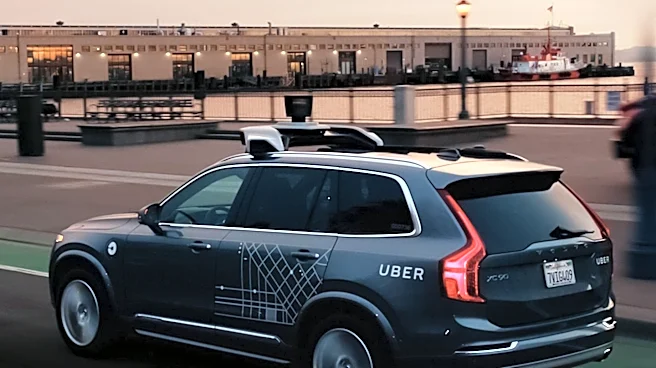
Nuro, an Uber partner, has obtained a permit for fully driverless testing in Santa Clara and San Mateo counties, allowing its autonomous vehicles to operate at speeds up to 45 mph. This development positions Nuro ahead of Tesla in California's driverless permitting
process. The company's proactive approach in filing for the permit has given it a significant head start, as Tesla has primarily focused its expansion efforts for autonomous vehicles in Texas. This permit enables Nuro to conduct unsupervised driverless operations in a key region of California, specifically the Bay Area. The move is seen as a strategic advantage for Nuro in the competitive landscape of autonomous vehicle technology.
Why It's Important?
Nuro's acquisition of this permit is important because it signifies a tangible step forward in the commercialization of driverless technology in California, a critical market for autonomous vehicles. By securing this permit, Nuro gains a competitive advantage over other companies, including Tesla, in deploying fully driverless services. This could lead to earlier market penetration and data collection for Nuro, potentially accelerating its development and refinement of autonomous systems. For consumers, this could mean the earlier availability of driverless delivery or ride-hailing services in the Bay Area. The development also highlights the varying regulatory approaches and speeds at which different states and companies are progressing in the autonomous vehicle sector, influencing investment and strategic decisions within the industry.
What's Next?
Following the permit acquisition, Nuro is expected to commence or expand its fully driverless testing operations in Santa Clara and San Mateo counties. Industry observers predict that Nuro could reach San Francisco Airport with unsupervised driverless service before Tesla, with estimates suggesting Tesla is still 12 to 16 months away from commercial driver-out service in California. This could intensify competition in the autonomous vehicle market, potentially prompting other companies to accelerate their permitting and deployment strategies in California. The success and safety record of Nuro's operations under this new permit will likely influence future regulatory decisions and public acceptance of driverless technology in the state.
Beyond the Headlines
This development underscores the complex interplay between technological advancement, regulatory frameworks, and market strategy in the autonomous vehicle industry. Nuro's early permit acquisition highlights the importance of navigating regulatory processes effectively to gain a competitive edge. It also brings into focus the differing philosophies on autonomous vehicle development, with Nuro's focus on specific use cases like delivery versus Tesla's broader ambition for full self-driving in passenger vehicles. The outcome of this race to deploy driverless services in California could set precedents for how autonomous technology is integrated into urban environments and accepted by the public, influencing future policy and investment in the sector.