





What's Happening?
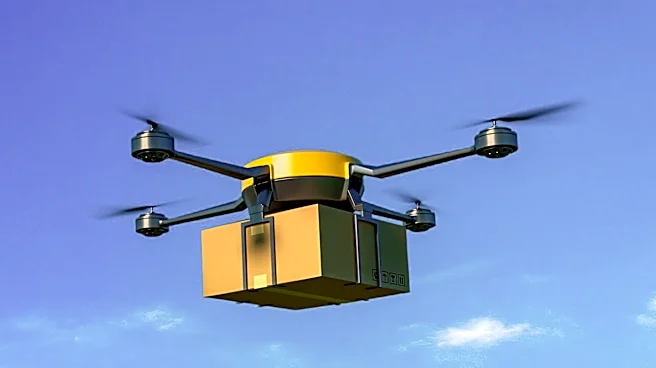
Wing, Alphabet's drone delivery subsidiary, announced a $125 million investment to construct a 15,000-square-foot manufacturing facility in Fort Worth, Texas, over the next two years. This investment aims to meet the increasing demand from retailers for
ultra-fast delivery services. The new facility is projected to produce tens of thousands of unmanned aerial aircraft annually, supporting Wing's ambitious plan to expand its drone delivery service nationwide. Wing currently operates in five metropolitan areas, including Central Florida, Houston, Atlanta, and Dallas-Fort Worth, and plans to expand to nearly 20 U.S. markets next year. This expansion, in partnership with Walmart, is expected to make drone delivery available to over 40 million people across more than 270 store locations, including major cities like Los Angeles, Cincinnati, San Diego, Miami, and Philadelphia. Wing's aircraft can carry up to five pounds of goods at speeds up to 60 mph and has completed over 1 million residential deliveries, typically within 30 minutes. The company is also piloting delivery programs with Lowe's and Panera.
Why It's Important?
This significant investment by Wing underscores the growing importance of drone technology in the U.S. retail and logistics sectors. The expansion of drone delivery networks, particularly through partnerships with major retailers like Walmart, signifies a shift towards more efficient and rapid last-mile delivery solutions. This development is crucial for consumers who increasingly expect convenience and speed in online ordering. The ability to deliver goods within 30 minutes addresses immediate consumer needs and could reshape purchasing habits. For businesses, drone delivery offers a competitive edge in the 'quick commerce wars,' potentially reducing delivery times and operational costs compared to traditional courier services or app-based platforms. The anticipated new U.S. rules from the Federal Aviation Administration (FAA) regarding beyond-visual-line-of-sight (BVLOS) operations are expected to further accelerate the adoption and scaling of commercial drone activities, making such investments strategically vital for companies positioning themselves in this evolving market.
What's Next?
The completion of Wing's manufacturing facility in Fort Worth, Texas, within the next two years will significantly boost its production capacity, enabling a broader rollout of drone delivery services across the U.S. The industry is keenly awaiting the Federal Aviation Administration's (FAA) final rule on beyond-visual-line-of-sight (BVLOS) operations, which is expected to be a catalyst for widespread commercial drone deployment. This rule, under review by the White House since July, will allow operators to scale drone delivery more broadly by permitting operations at or below 400 feet above ground level from pre-designated, secure-access locations. Operators will require FAA approval for flight areas and must utilize Automated Data Service Providers to ensure safe separation from other drones and manned aircraft. Large fleets like Wing's will need an FAA operating certificate, along with robust safety management systems and training programs. These regulatory advancements are critical for the full realization of Wing's expansion plans and the broader drone delivery ecosystem.
Beyond the Headlines
The expansion of drone delivery services, exemplified by Wing's investment, carries deeper implications for urban planning, infrastructure, and societal norms. The increased presence of drones in residential areas raises questions about noise pollution, privacy concerns, and air traffic management in low-altitude airspace. While companies like Zipline are actively re-engineering their drones to reduce noise, the cumulative impact of widespread drone operations on community living remains a significant consideration. Furthermore, the reliance on automated delivery systems could influence labor markets, potentially shifting employment from traditional delivery roles to specialized drone operation and maintenance. The regulatory framework being developed by the FAA will not only dictate operational safety but also shape public acceptance and the integration of this technology into daily life. The ethical considerations surrounding autonomous systems, data collection, and equitable access to these services will become increasingly prominent as drone delivery becomes more commonplace.