




What's Happening?
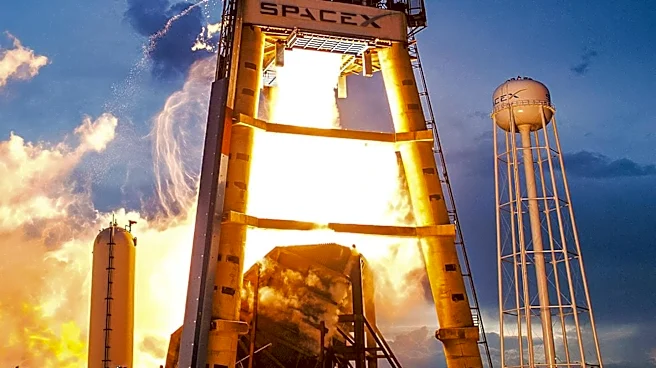
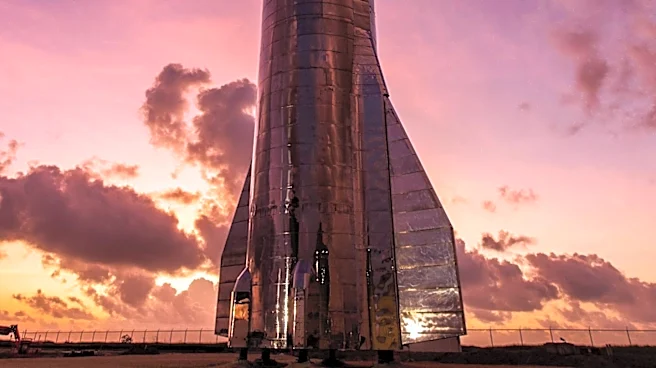
SpaceX has successfully conducted the first static fire test of Ship 40, marking a significant step forward in the development of its Starship program. This test, which took place at Starbase, Texas, involved igniting one of the spacecraft's central Raptor
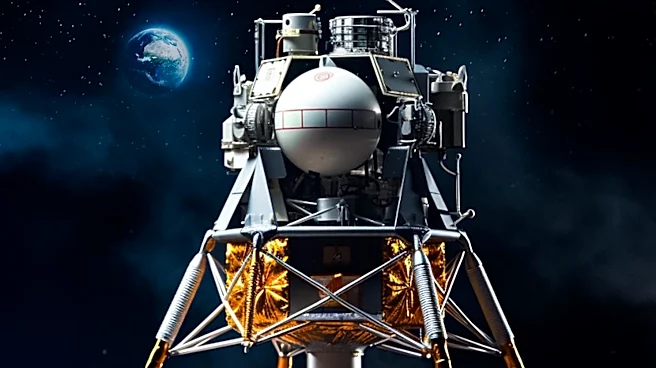
3 engines for approximately 15 seconds. The test is part of the prelaunch qualification campaign for the upcoming Flight 13 mission. Ship 40 is equipped with six Raptor 3 engines, three optimized for atmospheric flight and three for space operations. This milestone follows the maiden flight of the Starship Version 3 on May 22, which introduced new hardware improvements and the Raptor 3 engine architecture. SpaceX aims to use Starship for future missions, including NASA's Artemis program, which plans to use a modified Starship as a lunar lander.
Why It's Important?
The successful static fire test of Ship 40 is crucial for SpaceX's goal of developing a fully reusable launch system capable of supporting deep space missions. The ability to perform orbital refueling, a key feature of the Starship, is essential for missions beyond low Earth orbit. This capability is particularly important for NASA's Artemis program, which plans to use Starship for lunar landings. The rapid development and testing of Starship demonstrate SpaceX's commitment to advancing space exploration technology and its potential to revolutionize space travel by reducing costs and increasing mission frequency.
What's Next?
SpaceX plans to conduct additional tests involving all six engines of Ship 40 before it is cleared for flight. The company is also working on demonstrating in-orbit refueling, a complex operation that has yet to be tested. This capability is vital for the Artemis program, which requires multiple tanker launches to refuel the lunar landing version of Starship. As SpaceX continues to refine its technology, the company is poised to play a significant role in future space exploration missions, including those beyond the Moon.