







What's Happening?
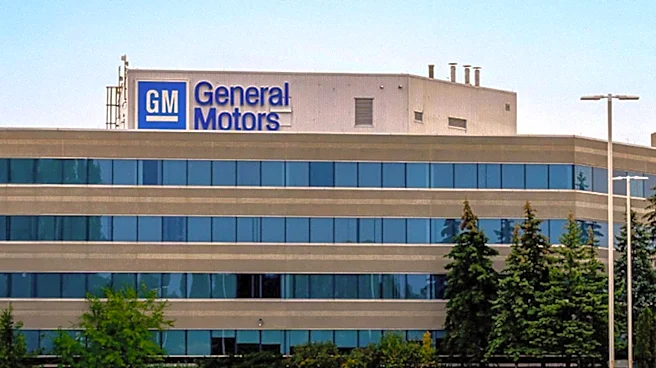
General Motors (GM) has officially moved its stock listing from the New York Stock Exchange (NYSE) to the Nasdaq, effective November 17. This marks a significant change for GM, which had been listed on the NYSE since 1911, with a brief interruption after
its 2009 bankruptcy. The ticker symbol for GM remains unchanged. The company stated that this move reflects its "technology-driven strategy," emphasizing its leadership in electric vehicles (EVs) and its rapidly expanding software and services business. The timing of the switch is notable, occurring two weeks before the Nasdaq's cutoff for ranking eligible companies by market value for annual index changes, which are typically announced in mid-December. This strategic timing positions GM for potential inclusion in the Nasdaq-100 index, which comprises the 100 largest non-financial companies listed on the Nasdaq.
Why It's Important?
The switch to Nasdaq holds significant implications for General Motors and its investors, primarily due to the potential for inclusion in the Nasdaq-100 index. Funds that track this index, such as the Invesco QQQ Trust, collectively manage over $600 billion and are mandated to purchase shares of every company within the index. If GM is added, this would trigger a substantial, one-time buying event from these index funds, potentially providing a short-term boost to GM's stock price. While this index inclusion does not fundamentally alter GM's business operations, vehicle sales, or profitability, it can create a temporary tailwind for the stock. For investors, it highlights how a company's listing venue can influence its visibility and demand from institutional investors tied to specific indices. This move also reinforces GM's narrative as a technology-forward company, aligning its market presence with its strategic focus on EVs and software.
What's Next?
The immediate next step for General Motors is to await the Nasdaq's annual index reconstitution announcement, typically made in mid-December. If GM's market capitalization qualifies it for inclusion in the Nasdaq-100, index funds will then be required to purchase its shares, which could lead to increased trading volume and a potential short-term price appreciation. Investors will be closely watching for this announcement and the subsequent market reaction. Beyond the potential index inclusion, GM will continue to focus on its core business strategies, including the expansion of its electric vehicle lineup, development of advanced software and services, and ongoing efforts to manage its financial performance. The long-term performance of GM's stock will ultimately depend on these fundamental business drivers rather than the one-time impact of an index inclusion.
Beyond the Headlines
GM's decision to move to Nasdaq is more than just a change of venue; it's a powerful symbolic statement about its evolving corporate identity. By aligning itself with a technology-centric exchange, GM is actively rebranding itself from a traditional automaker to a tech-driven mobility company. This strategic repositioning could influence how analysts, investors, and the public perceive the company, potentially attracting a new class of investors who prioritize technology and innovation. The move also reflects a broader trend where established industrial giants are seeking to leverage the prestige and investor base associated with tech-focused exchanges. While the immediate financial impact might be a one-time index bump, the long-term goal is likely to reshape GM's market narrative and valuation multiples, bringing them more in line with technology companies rather than traditional manufacturing firms.