



What's Happening?
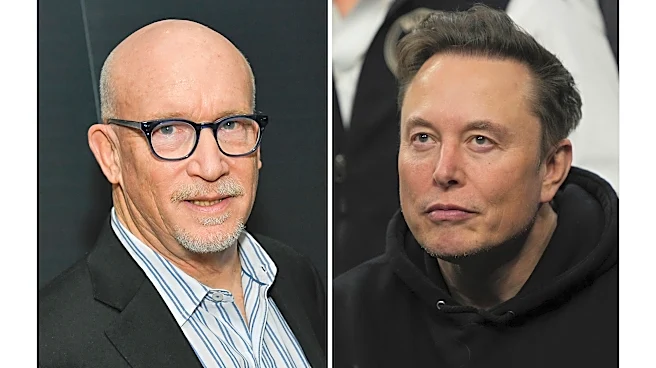
Oscar-winning director Alex Gibney revealed at the Venice Film Festival that he encountered a "tremendous sense of fear" among individuals he sought to interview for his new documentary, 'Musk,' which focuses on tech entrepreneur Elon Musk. This fear was
prevalent among Musk's critics, business colleagues, and even friends, with many declining to speak on record. Gibney noted that the story of Musk, despite its tech focus, echoes themes of confidence men and stock pumpers, similar to his previous works on Enron and Elizabeth Holmes. Journalist Zoë Schiffer, who participated in the documentary, suggested that while loyalty exists at the upper echelons of Musk's companies, lower-level employees are often treated harshly, making them more willing to speak out. Ashley St. Clair, Musk's ex-partner and mother of one of his children, also participated, citing a $40 million NDA offer she received from Musk as a motivation to speak the truth.
Why It's Important?
This documentary and the reported fear among interviewees highlight significant concerns about corporate power, free speech, and the influence of prominent figures like Elon Musk. The reluctance of individuals to speak publicly, even those close to Musk, suggests a chilling effect that can impact journalistic integrity and public discourse. The comparison of Musk's story to that of confidence men and stock pumpers by an acclaimed director like Gibney raises questions about the underlying financial mechanisms and ethical practices within some tech empires. Furthermore, the revelation of a substantial NDA offer to an ex-partner underscores the lengths to which powerful individuals may go to control narratives and silence potential critics. This situation has broader implications for transparency in business and the ability of the media to hold powerful figures accountable, especially in an era where tech leaders wield immense economic and social influence.
What's Next?
The release of Alex Gibney's documentary 'Musk' is expected to generate significant discussion and potentially draw reactions from Elon Musk himself, who has already posted about Gibney and the film on X. The film's portrayal of Musk's global political involvement, particularly his support for right-wing parties, could spark further debate about the intersection of tech leadership and political agendas. The documentary may encourage more individuals to come forward with their experiences, potentially leading to increased scrutiny of Musk's business practices and corporate culture. The themes explored in the film, such as the challenges of speaking truth to power and the impact of NDAs, could also fuel broader conversations about journalistic freedom and corporate accountability in the tech industry. The film's reception at the Venice Film Festival and its subsequent public release will be key in determining its immediate impact.
Beyond the Headlines
The 'tremendous sense of fear' surrounding Elon Musk, as described by Alex Gibney, points to a deeper cultural phenomenon where the immense power and influence of certain tech moguls can create an environment of self-censorship. This extends beyond legal repercussions to social and professional anxieties, impacting individuals' willingness to share their perspectives. The documentary's exploration of Musk's alleged 'unreality' and 'complicated relationship with the truth' touches upon the broader issue of how public figures shape narratives and the challenges in discerning fact from carefully constructed public images. Moreover, the film's assertion that Musk is involved with right-wing political parties globally, driven by both ideology and practical/monetary reasons, suggests a significant shift in how tech leaders engage with and influence international politics. This could lead to a re-evaluation of the responsibilities and ethical boundaries of tech leadership in a globalized world.