






What's Happening?
Optivolt, a power electronics company based in San Francisco, has announced a $32 million Series A funding round. The investment was led by VXI Capital, a new hard tech fund, with additional participation from RA Capital, Valo Ventures, and Atlas Innovate,
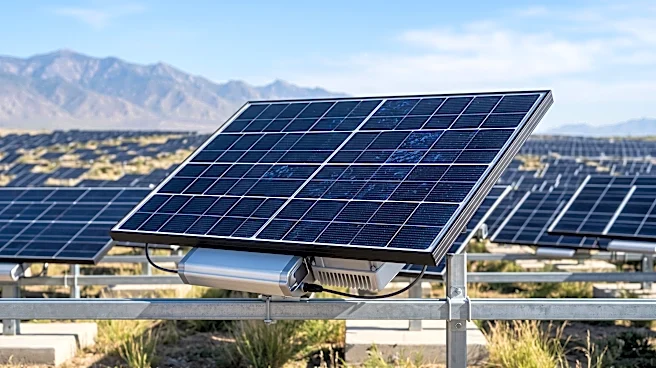
bringing Optivolt's total capital raised to $42 million. The company has spent nine years developing its core technology, the Power Balancer, which embeds active power electronics directly into solar panels. This technology enables real-time energy management among cell groups within the panel, recovering power that would otherwise be lost due to factors like shade, weather, dirt, and uneven degradation. Optivolt's Power Balancer operates with 99.4% conversion efficiency under typical conditions and replaces conventional bypass diodes, integrating rapid shutdown and monitoring capabilities directly into the panel. Over 20,000 panels incorporating the Power Balancer have already been shipped, and the new funding will be used to expand manufacturing and deploy the technology across various solar system scales, from residential to utility-scale projects, including those powering AI data centers.
Why It's Important?
This funding and technological advancement are significant for the U.S. solar industry and its energy infrastructure. Traditional solar panels are passive hardware, meaning their performance can be severely impacted by localized issues like shade or dirt, which can reduce the output of an entire cell group. Optivolt's intelligent panels address this limitation by actively managing energy at the module level, maximizing power generation in real-world conditions. This innovation can lead to higher energy yields, improved system reliability, and reduced operational costs for solar installations across the U.S. For consumers, it means more efficient home solar systems. For businesses and utility providers, it translates to more predictable and robust energy production, which is critical for integrating solar into the national grid and supporting energy-intensive operations like AI data centers. The investment also signals growing confidence in U.S. innovation in renewable energy technology, potentially fostering job creation and economic growth in the clean tech sector.
What's Next?
Optivolt plans to utilize the newly secured $32 million to scale up its manufacturing capabilities and broaden the deployment of its Power Balancer technology. The company aims to integrate its intelligent solar panels into a wider range of applications, from individual residential installations to large-scale utility projects. This expansion will include targeting the growing energy demands of AI data centers, positioning Optivolt as a key player in providing reliable and efficient solar power solutions for emerging technologies. The company will also continue to leverage its 19 issued patents and 27 pending applications to solidify its position in panel-integrated power electronics. Furthermore, Optivolt's long-term vision is to transform every solar panel into an intelligent, connected node within a global energy network, capable of self-management and coordination with the broader energy system. This suggests future developments will focus on enhanced connectivity and smart grid integration for solar assets.
Beyond the Headlines
The deeper implications of Optivolt's technology lie in its potential to fundamentally redefine the architecture of solar energy systems. By embedding intelligence directly into the panel, it moves beyond incremental efficiency gains to create a truly adaptive and resilient solar infrastructure. This shift could lead to a more decentralized and robust energy grid, less susceptible to localized disruptions. Ethically, it promotes a more efficient use of resources by maximizing the energy output from installed solar capacity, reducing the need for additional panels or backup power. Legally, the integration of advanced electronics and rapid shutdown features could influence safety standards and regulatory frameworks for solar installations. Culturally, it reinforces the narrative of solar energy as a sophisticated, high-tech solution, attracting further investment and talent into the renewable energy sector. In the long term, this approach could pave the way for solar panels to become active participants in smart energy management, contributing to grid stability and energy independence.