








What's Happening?
The International Monetary Fund (IMF) is advising central banks, particularly those in emerging economies like Nigeria, to discontinue rigid forward guidance on interest rates. This recommendation comes as the IMF observes that such fixed commitments
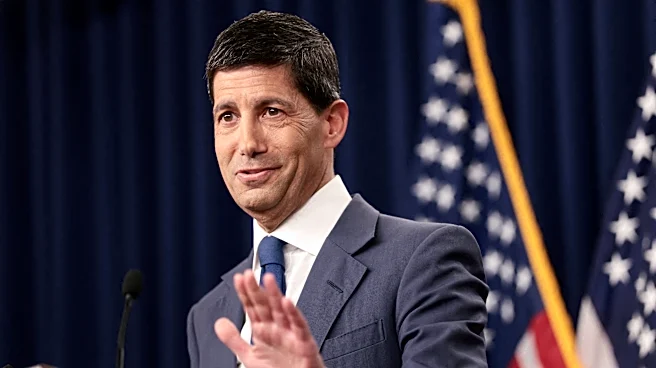
are losing effectiveness due to repeated supply shocks. Tobias Adrian, director of the Monetary and Capital Markets Department, highlighted that overly specific promises about future interest rate levels compel central banks to make sudden adjustments, which in turn increases market volatility. The IMF suggests that central banks should instead prioritize transparency regarding their responses to macroeconomic indicators. Quantitative projections, according to the IMF, should be reserved for exceptional circumstances and always include explicit exit clauses. The institution also cautioned against the excessive accumulation of institutional details that are scrutinized by algorithms and artificial intelligence, arguing that this 'informational noise' distracts investors from economic fundamentals and distorts price formation.
Why It's Important?
This shift in IMF guidance is significant for global monetary policy, especially for the U.S. and other major economies. The U.S. Federal Reserve, like many central banks, has historically used forward guidance to manage market expectations and influence economic activity. Abandoning rigid guidance could lead to more agile and data-dependent monetary policy decisions, potentially increasing market uncertainty in the short term but allowing for greater flexibility in responding to unforeseen economic shifts. For U.S. businesses and investors, this could mean a less predictable interest rate environment, requiring more dynamic financial planning and risk management. The IMF's concern about 'informational noise' from AI and algorithms also underscores a growing challenge in financial markets, where rapid, automated analysis of vast amounts of data can sometimes obscure underlying economic realities, potentially leading to mispricing of assets and increased volatility. This could prompt U.S. regulators and financial institutions to re-evaluate how they interpret and react to central bank communications.
What's Next?
Central banks globally, including the U.S. Federal Reserve, will likely review their communication strategies in light of the IMF's recommendations. While a complete overhaul of forward guidance might not happen immediately, there could be a gradual move towards more flexible and less prescriptive statements about future interest rate paths. This could involve central banks emphasizing their data-dependent approach more explicitly and providing clearer caveats for any forward-looking statements. Market participants, including investors and financial analysts, will need to adapt to a potentially less certain monetary policy landscape, focusing more on real-time economic data and central bank reactions rather than relying on long-term guidance. This could lead to increased short-term market volatility as interpretations of economic indicators become more critical. Additionally, there might be a push for greater clarity from central banks on how they intend to manage the impact of AI and algorithmic trading on market perceptions of their communications.
Beyond the Headlines
The IMF's advice touches upon a deeper philosophical debate about the role of central banks in modern, technologically advanced financial markets. The tension between providing clear guidance to anchor expectations and maintaining flexibility to respond to dynamic economic conditions is a persistent challenge. The rise of AI and algorithmic trading adds another layer of complexity, as these technologies can amplify market reactions to even subtle shifts in central bank communication. This situation highlights the need for central banks to not only refine their communication strategies but also to understand and potentially mitigate the unintended consequences of technological advancements on market behavior. The long-term implication could be a re-evaluation of how transparency is defined in monetary policy, moving from explicit commitments to a more nuanced approach that emphasizes adaptability and responsiveness while still fostering market confidence.