


What's Happening?
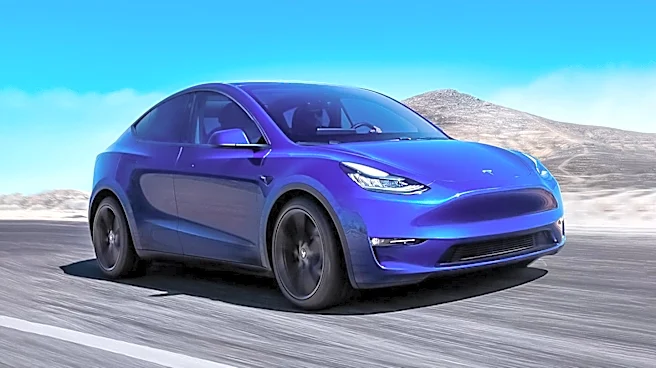
Tesla CEO Elon Musk announced that the 15th major release of its Full Self-Driving (FSD) AI, version 15, will be widely released to customer-owned vehicles in December 2026. This update will be bundled with Tesla's annual Holiday Update, which typically
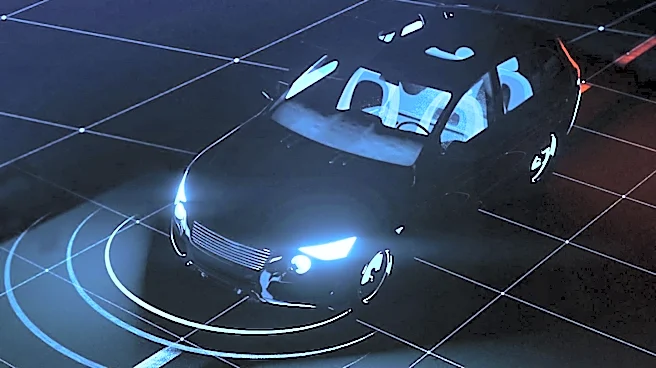
includes new infotainment features. Musk stated that FSD v15 will be 'something special' and will feature a new user interface capable of rendering reality in a 'mind-bending' way. Tesla has shifted its AI development approach since FSD v12, moving away from extensive C++ code and hard-coded instructions. Instead, the FSD AI's neural network learns entirely from video and telemetry data collected from Tesla's global fleet, emphasizing self-learning over supervised fine-tuning. FSD v15 is expected to increase the parameter count by tenfold, from 1 billion to 10 billion, following a similar increase with FSD v14. This upcoming update will only be available for Tesla vehicles equipped with Hardware 4 (HW4/AI4).
Why It's Important?
The release of FSD v15 represents a significant advancement in Tesla's autonomous driving technology, potentially enhancing vehicle safety and convenience for owners. The shift towards a self-learning AI model, which relies on real-world data rather than explicit programming, could accelerate the development of more robust and adaptable autonomous systems. This approach aims to create an AI that can independently learn and navigate complex driving scenarios, potentially reducing the need for human intervention. The integration of FSD v15 with the Holiday Update also highlights Tesla's strategy of combining core technological advancements with user-facing features, aiming to increase customer satisfaction and adoption of its premium software offerings. The tenfold increase in AI parameters suggests a substantial leap in the system's processing capabilities and understanding of driving environments, which could set new benchmarks in the autonomous vehicle industry. However, the exclusivity of FSD v15 to HW4 vehicles means that owners of older hardware will not benefit from this latest iteration, potentially creating a divide in the user experience.
What's Next?
Tesla is expected to first release FSD v15 to a limited number of early access users to gather safety feedback and data. Following this initial phase, a wider release to customer vehicles is anticipated within days to a week. The 2026 Holiday Update, including FSD v15, is typically rolled out approximately two weeks before Christmas, indicating a busy period for Tesla's AI and software teams. The company will likely continue to refine its self-learning AI model based on the vast amounts of data collected from its fleet, further enhancing the system's capabilities and addressing any emerging issues. Future developments may include expanding the availability of unsupervised FSD beyond geofenced areas, as FSD v15 is currently used for autonomous ride-hailing in select Texas and Florida cities. The performance and safety record of FSD v15 in wide release will be closely monitored by regulators, consumers, and competitors, influencing the broader adoption and perception of autonomous driving technology.
Beyond the Headlines
The continuous evolution of Tesla's FSD AI, particularly its reliance on self-learning from real-world data, raises profound implications for the future of artificial intelligence and automotive engineering. This approach challenges traditional software development paradigms by minimizing hard-coded rules in favor of neural networks that learn from experience, mirroring biological learning processes. Ethically, the development of AI that learns from human driving habits, including imperfections, presents a complex challenge: how to ensure the AI adopts safe behaviors while discarding unsafe ones. The 'mind-bending' reality renders promised for the new UI could also redefine the human-machine interface in vehicles, making the car's perception of its surroundings more intuitive and immersive for the driver. Legally, the increasing autonomy of these systems will continue to push boundaries regarding liability in the event of accidents, as the line between human and AI responsibility blurs. Culturally, widespread adoption of such advanced autonomous systems could fundamentally alter driving as an activity, impacting urban planning, personal mobility, and even the concept of vehicle ownership.