


What's Happening?
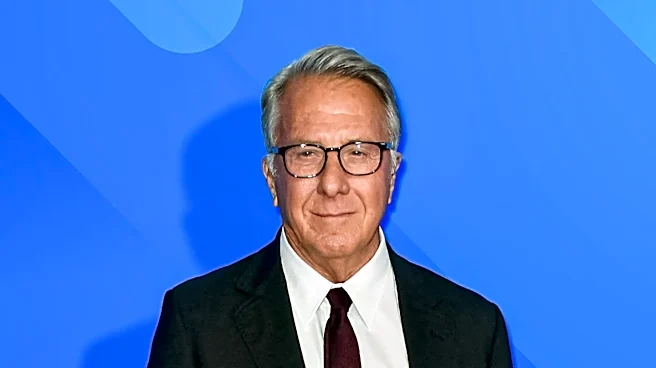
Nearly 90-year-old actor Dustin Hoffman has released his new memoir, 'Look at Me,' co-written with New Yorker staff writer Ariel Levy. In the book, Hoffman reflects on his extensive career and personal life, including his early struggles, his breakthrough
role in 'The Graduate,' and his experiences working on various films. He recounts his humble beginnings in Los Angeles, being bullied, and his family's expectation for him to join the furniture business. Hoffman details his time as a struggling actor in New York with Gene Hackman and Robert Duvall, sharing anecdotes about their shared apartment and Hackman's unusual need to 'get into a fight.' The memoir also touches on his two marriages, his children, and significant moments like meeting Eddie Vedder during a 'Death of a Salesman' production. Hoffman describes his transformation for 'Tootsie' as 'demoralizing' and reveals that his famous line in 'Midnight Cowboy' was improvised. The book also briefly addresses the #MeToo allegations against him, where he compares himself to a victim of the McCarthy era and denies the accusations.
Why It's Important?
Dustin Hoffman's memoir, 'Look at Me,' offers a significant contribution to the cultural and historical record of Hollywood, providing an insider's perspective on a career spanning over half a century. His reflections on the challenges of breaking into the industry, the dynamics of working with legendary figures like Laurence Olivier, and the personal toll of transformative roles like 'Tootsie' offer valuable insights into the craft of acting and the pressures of celebrity. The book's candid portrayal of his early struggles alongside Gene Hackman and Robert Duvall highlights the shared experiences of aspiring artists and the camaraderie that can form in such environments. The brief mention of the #MeToo allegations, while not extensively detailed, is important as it reflects a prominent actor's perspective on a pivotal moment in recent social history, even if it is presented from a defensive stance. This memoir serves as a historical document, capturing the evolution of a prominent actor and the changing landscape of the entertainment industry.
What's Next?
The release of Dustin Hoffman's memoir 'Look at Me' is likely to generate renewed public interest in his career and personal life. The book's content, particularly his reflections on the #MeToo allegations, may spark further discussions and media coverage, potentially leading to interviews or public appearances where he might elaborate on these topics. For fans of classic Hollywood, the memoir offers a chance to revisit iconic films and gain new perspectives on their creation. The book's success could also influence other veteran actors to share their own stories, contributing to a growing trend of celebrity memoirs. Academics and film historians may find the memoir a valuable primary source for understanding the evolution of acting techniques, the studio system, and the cultural shifts within the entertainment industry over several decades. The memoir's reception will also indicate how the public and critics engage with the personal narratives of figures who have faced public scrutiny.
Beyond the Headlines
Dustin Hoffman's memoir, 'Look at Me,' transcends a simple recounting of a celebrity's life, offering a deeper exploration of identity, ambition, and the enduring impact of personal history on artistic expression. His self-perception as a 'failure' despite immense success speaks to the psychological complexities often hidden beneath public personas, highlighting the internal struggles that can drive creative individuals. The book's structure, which 'flits through time,' mirrors the fragmented nature of memory and the way past experiences continually shape the present. The inclusion of his early struggles with Hackman and Duvall underscores the often-overlooked collaborative and communal aspects of artistic development before individual stardom. Furthermore, his brief but pointed commentary on the #MeToo era, comparing it to the McCarthy era, reveals a generational perspective on public accountability and the challenges of navigating evolving social norms. This memoir, therefore, becomes a lens through which to examine not only Hoffman's life but also broader themes of artistic resilience, the burden of fame, and the ongoing dialogue between personal narrative and public perception.