



What's Happening?
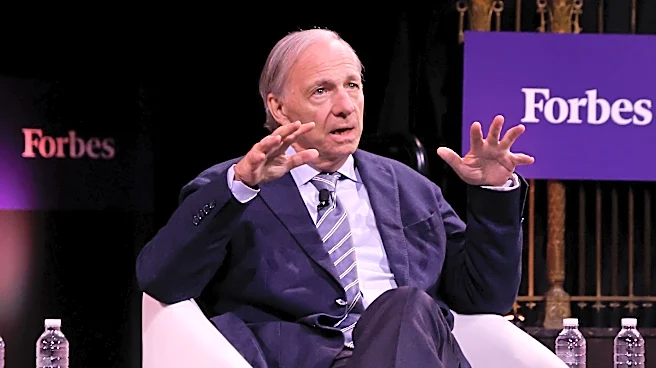
Ray Dalio, the self-made billionaire founder of Bridgewater Associates, recently shared his perspectives on wealth and happiness at the Milken Institute Asia Summit in Singapore. Dalio, whose net worth is nearly $22 billion according to the Bloomberg
Billionaire Index, stated that beyond a certain level, happiness is not correlated with wealth. He emphasized that a sense of community is the greatest determinant of happiness. Dalio, along with his wife Barbara Dalio, has committed to donating a significant portion of their wealth to philanthropic causes. He also highlighted adaptability as a key factor for success, noting that it is more crucial than intelligence.
Why It's Important?
Dalio's comments are significant as they come from a prominent figure in the financial world, whose insights often influence broader discussions on economic philosophy and personal well-being. His emphasis on community over material wealth challenges conventional notions of success, particularly in a society often driven by financial accumulation. For U.S. economic stakeholders, his philanthropic pledges reflect a growing trend among the ultra-wealthy to address societal issues, potentially redirecting substantial private capital towards public good. This perspective could also influence how businesses and individuals perceive their roles in fostering community and collective well-being, rather than solely focusing on profit maximization.
What's Next?
While Dalio's recent comments were philosophical, his ongoing philanthropic efforts with Barbara Dalio are expected to continue channeling significant resources into various causes. These initiatives could inspire other wealthy individuals and corporations to increase their charitable contributions and engage more deeply in community-building efforts. His views on adaptability might also encourage a re-evaluation of educational and professional development strategies, emphasizing skills that promote resilience and flexibility in a rapidly changing world. The broader impact could be a shift in corporate social responsibility discussions, moving beyond mere compliance to more integrated community engagement.
Beyond the Headlines
Dalio's remarks delve into the ethical and cultural dimensions of wealth, suggesting that true fulfillment extends beyond financial metrics. This perspective could foster a deeper societal conversation about the purpose of wealth and the responsibilities of those who accumulate it. His focus on community as a primary driver of happiness touches upon fundamental human needs often overlooked in the pursuit of economic success. This could lead to a re-evaluation of societal values, potentially encouraging policies and cultural norms that prioritize social cohesion and collective welfare over individual material gain. The long-term shift could be towards a more holistic understanding of prosperity, encompassing both economic stability and social well-being.