




What's Happening?
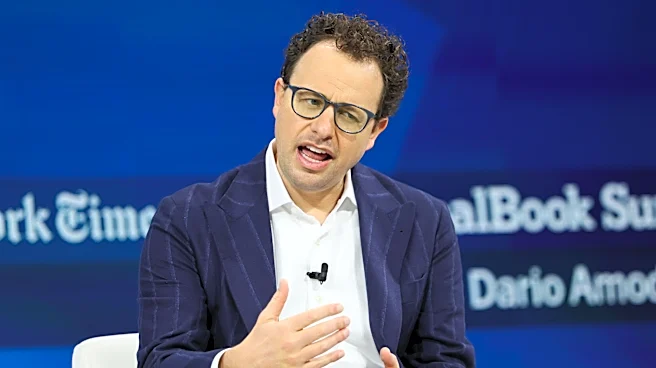
Anthropic CEO Dario Amodei recently engaged in a conversation with JPMorgan Chase CEO Jamie Dimon at the Anthropic IPO roadshow, introduced by Mary Erdos, CEO of JPMorgan Asset and Wealth Management. Amodei detailed Anthropic's strategic focus on talent
and culture as key differentiators in the competitive AI landscape, emphasizing a disciplined approach to hiring that prioritizes collaboration and public benefit. He highlighted the widespread enterprise adoption of Anthropic's AI model, Claude, across various sectors including coding, financial services, insurance, legal, life sciences, e-commerce, and manufacturing. Amodei also addressed the critical importance of AI agent safety, noting Anthropic's significant investments in safeguards and alignment to prevent agents from operating uncontrollably. The discussion also touched upon the company's substantial $900 billion compute commitments, a major business dilemma due to the rapid technological growth and the need to secure compute resources years in advance. Amodei explained their strategy of buying compute on the low side and utilizing the spot market for additional needs, supported by strong gross margins and cash reserves. He also discussed the company's decision to go public, primarily to secure more cash for compute investments and maintain a buffer against market uncertainties.
Why It's Important?
This discussion underscores the growing integration of advanced AI technologies into core business operations across U.S. industries. Anthropic's emphasis on safety and enterprise focus highlights a critical trend where AI developers are prioritizing responsible deployment, which is crucial for regulated sectors like financial services and healthcare. JPMorgan Chase's extensive use of Claude, with 250,000 employees utilizing it weekly, demonstrates the transformative potential of AI in enhancing efficiency and client services within large corporations. The substantial compute commitments by Anthropic reflect the immense capital expenditure required to develop and scale frontier AI models, indicating a significant investment cycle in the technology sector. This also signals potential shifts in the competitive landscape, as companies like Anthropic aim to differentiate themselves not just through technological prowess but also through ethical development and robust safety protocols. The IPO itself is a significant event, as it will provide Anthropic with the capital needed to continue its aggressive R&D and infrastructure build-out, potentially accelerating AI advancements and their broader economic impact.
What's Next?
Anthropic's IPO is a significant next step, aiming to secure additional capital to fund its extensive compute commitments and further its research and development in AI. This public offering will likely increase scrutiny on the company's financial performance, safety protocols, and ethical AI development practices. The company plans to continue its focus on expanding enterprise adoption of Claude, with ongoing efforts to apply AI to increasingly complex challenges in scientific discovery, life sciences, robotics, and cybersecurity. Amodei anticipates that AI will continue to address current limitations in various fields, from curing diseases to enhancing cybersecurity defenses. The establishment of a public benefit fund, comprising 5% of the company, indicates a long-term commitment to addressing societal challenges such as wealth concentration and ensuring a smooth labor transition with AI. This fund will also focus on biosecurity, aiming to mitigate potential misuses of advanced biological AI applications. The company's continued investment in safety and alignment will be crucial as AI agents become more capable, with ongoing efforts to control and limit their actions in sensitive systems.
Beyond the Headlines
The conversation between Amodei and Dimon reveals deeper implications beyond immediate business strategies, touching upon the ethical and societal dimensions of advanced AI. Anthropic's commitment to a 'public benefit fund' and co-founders pledging 80% of their wealth to charity signals a growing awareness within the AI industry of its potential to exacerbate wealth concentration and societal inequalities. This proactive approach suggests a nascent trend where leading AI companies are attempting to integrate social responsibility into their core business models, potentially influencing future corporate governance in the tech sector. The discussion on AI's potential to solve 'unsolved problems' in mathematics, cure diseases like cancer and Alzheimer's, and revolutionize scientific discovery highlights the profound long-term impact AI could have on human civilization, akin to a new 'Enlightenment.' However, Amodei also candidly addresses serious risks, including misuse for bio or cyber warfare, economic disruptions, and the potential loss of control over AI agents. This dual focus on transformative potential and existential risks underscores the complex ethical tightrope the AI industry is walking, necessitating continuous dialogue and collaboration between technologists, policymakers, and society at large to ensure beneficial outcomes.