



What's Happening?
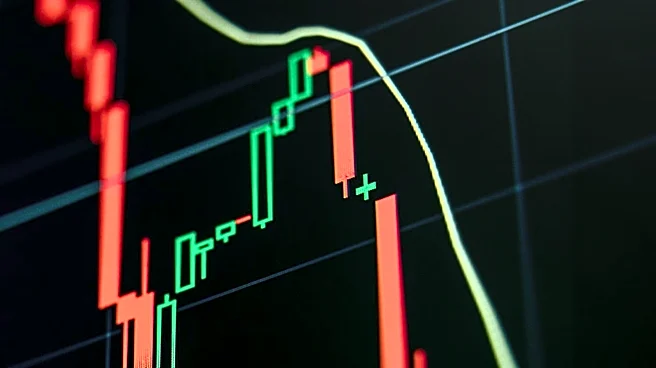
Chainlink's price has experienced a 4.8% decline over the past week, despite significant developments in its technology. UBS recently utilized Chainlink's software to automate a tokenized structured note on the Ethereum blockchain. This structured note functions
as a bank-issued bond whose returns are tied to other assets. Additionally, Chainlink's price feeds now incorporate tokenized shares of Anthropic, enabling cryptocurrency applications to price the AI company's stock. These advancements aim to provide external data, such as prices, to blockchains through Chainlink's oracle network. Despite these integrations, the LINK token's market performance has not reflected these positive developments, with its price falling alongside a broader market downturn where XRP also saw a 30.2% drop over the last month, and Chainlink itself fell 29.3%.
Why It's Important?
The recent price decline of Chainlink, despite its integration with a major financial institution like UBS and its expansion into AI stock pricing, highlights the volatile nature of the cryptocurrency market and the challenges in translating technological advancements into immediate market value. For investors, this situation underscores the importance of long-term potential versus short-term price fluctuations. The adoption of Chainlink's oracle network by traditional finance entities like UBS signifies a growing interest in blockchain technology for automating financial instruments. However, the lack of a positive price reaction suggests that institutional adoption alone may not be sufficient to drive immediate token appreciation, especially amidst broader market selling pressure. This scenario could influence how other blockchain projects approach partnerships and market communication, emphasizing the need for clear value accrual to their native tokens.
What's Next?
The future trajectory of Chainlink's price will likely depend on whether its banking collaborations and integrations, such as the one with UBS, begin to translate into sustained, high-volume, and fee-generating usage that directly benefits the LINK token. Ripple's credit initiative, which aims to use XRP as loan collateral, is also a key development in the broader crypto market that could influence investor sentiment. While some analysts project significant price increases for both XRP and Chainlink by 2028, these forecasts are contingent on widespread adoption of their services beyond current pilot projects. The market will be watching for further details on Ripple's credit service rollout in 2027 and whether Chainlink's institutional partnerships move from exploration to production systems, providing more concrete evidence of value creation.
Beyond the Headlines
The disparity between Chainlink's technological progress and its market performance raises questions about the maturity of the decentralized finance (DeFi) space and the metrics used to evaluate success. While institutional adoption is often seen as a bullish indicator, this case suggests that the market may be looking for more tangible evidence of revenue generation or token utility directly linked to these partnerships. It also highlights the ongoing tension between the decentralized ethos of blockchain and the centralized nature of traditional finance. The integration of tokenized assets and structured notes on public blockchains could represent a significant shift in how financial products are created and managed, potentially leading to greater transparency and efficiency, but also introducing new regulatory and operational complexities that the market is still grappling with.