


What's Happening?
XPENG's robotics business has successfully raised over $900 million in an initial financing round, achieving a post-money valuation exceeding $6.2 billion. This funding, led by IDG Capital with participation from Gaorong Ventures and strategic investments
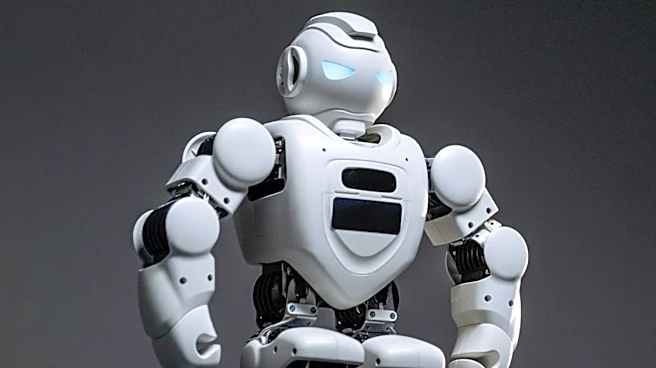
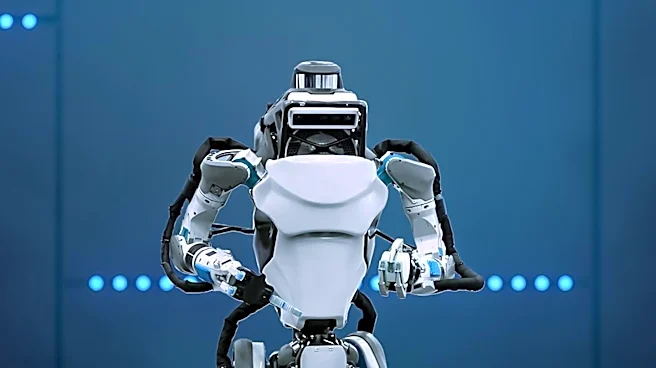
from Tencent and Alibaba, is earmarked for the development and mass production of its humanoid robot, Iron. XPENG, an electric-vehicle manufacturer, plans to begin scaled production of Iron by the end of 2026. Initial commercial deployments are anticipated at XPENG stores and campuses, followed by use in the company's own commercial settings and selected external applications in the first half of 2027. The Iron robot incorporates a full in-house technology stack, including its body, AI 'brain,' motion-control systems, data, and infrastructure, featuring 76 degrees of freedom across its body and 21 degrees of freedom in each hand, powered by three Turing AI chips providing up to 2,250 TOPS of computing power.
Why It's Important?
This significant investment in XPENG's robotics unit highlights a growing trend of automotive companies diversifying into advanced AI and robotics, leveraging their manufacturing and technological expertise. For the U.S. and global technology sectors, this development signals increasing competition and innovation in the humanoid robotics market. The application of automotive-grade manufacturing and supply-chain relationships to robotics could accelerate the development and deployment of humanoid robots, potentially making them more accessible and cost-effective. The integration of Turing AI chips and autonomous-driving data capabilities from XPENG's automotive operations into robotics could lead to more sophisticated and capable robots. This could have profound implications for various industries, including manufacturing, logistics, and service sectors, by introducing new forms of automation and human-robot collaboration. The potential for recurring revenue from AI-model upgrades, software, and related services also indicates a shift towards a service-oriented model in robotics, creating new economic opportunities.
What's Next?
XPENG plans to formally launch Iron in 2027 for external retail and service-sector customers in China and overseas. The company projects that monthly production capacity could reach several thousand units next year, depending on market demand. While a full-year delivery target has not been provided, management expects Iron hardware gross margins to surpass those of its vehicle business, with potential for significant recurring revenue from AI-model upgrades and software. Vice Chairman and President Brian Gu noted that while it's too early to provide a profitability timeline or volume guidance, humanoid robots are expected to have greater gross-profit potential and potentially require lower investment and capital expenditures once production scales. The robotics unit remains consolidated with XPENG's operations, with an 18-month period to work towards a potential separation, though the current focus is on operational synergies between the vehicle and robotics businesses.
Beyond the Headlines
The venture of an electric vehicle manufacturer like XPENG into humanoid robotics underscores a broader convergence of AI, advanced manufacturing, and automation technologies. This move suggests a future where the lines between different high-tech industries become increasingly blurred, with innovations in one sector rapidly transferable to another. The development of humanoid robots capable of performing complex tasks could lead to significant societal shifts, including changes in labor markets, the nature of work, and human-robot interaction. Ethical considerations surrounding the deployment of such advanced AI-powered robots, including job displacement, safety protocols, and the potential for autonomous decision-making, will become increasingly pertinent. Furthermore, the strategic investments from tech giants like Tencent and Alibaba indicate a recognition of the long-term potential of humanoid robotics as a foundational technology, capable of transforming multiple aspects of daily life and industry beyond just the automotive sector.