





What's Happening?
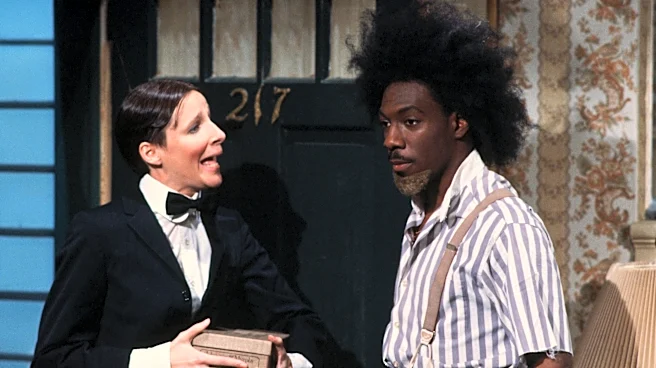
A 2013 'Saturday Night Live' sketch titled 'White Christmas' satirized the conventions of Black holiday movies by reimagining them with an all-white cast. The sketch presented a mock trailer for a film pitched as 'the first Black holiday movie for a white audience.'
It featured a mother losing her house to foreclosure just before Christmas, leading her to move in with her mother, Mama Ruth, along with her unwilling son Rashid. The trailer showcased various tropes commonly found in Black holiday films, including friends gossiping while snapping peas, a grandmother brandishing a handgun, a dinner guest with a chain over his turtleneck, and a preacher leading a gospel choir. Mock critics provided blurbs ranging from delighted to dismayed, and the closing credits humorously billed Paul Rudd three times. The sketch included cast members such as Vanessa Bayer, Cecily Strong, Jay Pharoah, Kyle Mooney, Aidy Bryant, Noel Wells, Kenan Thompson, Bobby Moynihan, Mike O'Brien, and Brooks Wheelan.
Why It's Important?
This 'Saturday Night Live' sketch is significant for its use of satire to highlight and critique racial representation and stereotypes in popular culture, specifically within the holiday film genre. By reversing the racial dynamic and applying common tropes of Black holiday movies to an all-white cast, the sketch forces viewers to confront the often-unexamined assumptions and clichés present in media. It sparks a conversation about who gets to tell certain stories, for whom, and how those narratives are constructed. The sketch's humor derives from the unexpected juxtaposition, drawing attention to the distinct cultural markers and narrative patterns that have become associated with specific racial groups in film. This kind of comedic commentary can be a powerful tool for social critique, prompting audiences to think more deeply about media consumption and representation.
What's Next?
While the sketch aired in 2013, its themes remain relevant in ongoing discussions about diversity and representation in Hollywood. The continued production of holiday films, and indeed all genres, will likely face increased scrutiny regarding their portrayal of various communities. The legacy of sketches like 'White Christmas' contributes to a broader cultural dialogue that encourages creators to be more mindful of stereotypes and to strive for more nuanced and authentic representations. This type of satire can influence future comedic and dramatic productions, pushing for more inclusive storytelling and challenging conventional portrayals. The sketch serves as a reminder that humor can be an effective way to address sensitive social issues and promote critical thinking about media content.
Beyond the Headlines
The 'White Christmas' sketch delves into the deeper implications of cultural appropriation and the commodification of cultural experiences. By presenting a 'Black holiday movie for a white audience,' it subtly questions whether certain cultural narratives are being 'translated' or 'repackaged' for different demographics, and what might be lost or distorted in that process. The sketch also touches on the idea of 'othering' in media, where the experiences of one group are presented as distinct or exotic when viewed through the lens of another. The critical reception within the sketch, with some critics 'delighted' and others 'dismayed,' mirrors real-world debates about the appropriateness and effectiveness of such satirical approaches. Ultimately, the sketch serves as a cultural artifact that reflects and comments on the complex interplay of race, media, and audience perception in American society.