
What's Happening?
Offset printing generally surpasses digital printing in cost-effectiveness for commercial jobs requiring over a thousand copies. This is due to the plate-based nature of offset printing, where the initial
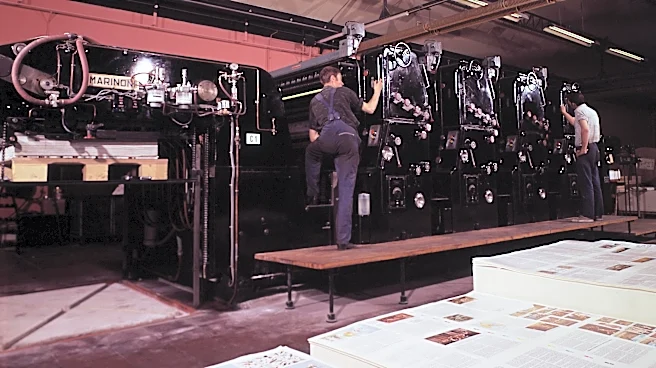
setup cost for burning artwork onto plates remains constant regardless of the print quantity. As the volume of prints increases, the per-piece cost significantly decreases. For quantities below a thousand, digital printing typically offers faster and more economical solutions. The Komori offset machine, a common industrial press, accommodates two standard sheet sizes: 19" × 26" and 20" × 30". The selection of the appropriate sheet size is crucial for optimizing paper utilization and minimizing waste, with proper planning ensuring efficient layout before quoting. The process involves transferring inked artwork from plates to the sheet via a rubber blanket, a method that becomes more efficient with higher print runs.
Why It's Important?
This distinction between offset and digital printing methods holds significant implications for businesses and commercial clients in the U.S. printing industry. Companies requiring large volumes of printed materials, such as brochures, catalogs, or posters, can achieve substantial cost savings by opting for offset printing once their order exceeds approximately one thousand units. This economic advantage allows businesses to allocate their budgets more efficiently, potentially enabling larger marketing campaigns or reducing operational costs for printed collateral. Conversely, smaller businesses or those needing quick turnarounds for limited quantities will find digital printing more advantageous. Understanding this crossover point is critical for procurement managers and marketing departments to make informed decisions that impact their bottom line and project timelines. The choice directly influences production costs, turnaround times, and the overall quality of printed materials, affecting various sectors from advertising to publishing.
What's Next?
Businesses planning print jobs will need to carefully assess their quantity requirements to determine the most cost-effective printing method. Printing service providers are likely to continue offering both offset and digital options, often providing comparative quotes to help clients make informed decisions. The trend suggests that for high-volume commercial orders, offset printing will remain the preferred choice due to its inherent cost efficiencies at scale. Clients will also need to consider factors beyond just quantity, such as specific paper types, finishing requirements, and turnaround times, as these can influence the overall project cost and feasibility. As technology evolves, the threshold at which offset becomes more economical than digital might shift, prompting ongoing evaluation by both printers and their clients.
Beyond the Headlines
The enduring relevance of offset printing in an increasingly digital world highlights the nuanced interplay between technology, cost, and quality in manufacturing. While digital printing offers flexibility and personalization, offset printing continues to dominate large-scale commercial production due to its superior cost-per-unit for high volumes and often higher print quality for certain applications. This dynamic underscores a broader economic principle where initial fixed costs (like plate creation) can be amortized over a larger output, leading to greater efficiency. The industry also faces ongoing challenges in sustainability, with both methods having environmental footprints related to ink, paper, and energy consumption. The strategic choice between offset and digital also reflects a company's brand image and commitment to quality, as the tactile experience of printed materials remains a significant factor in consumer perception.