








What's Happening?
A detailed comparison between Japanese Jiu-Jitsu and Brazilian Jiu-Jitsu (BJJ) highlights their shared history and divergent training methodologies. Japanese Jiu-Jitsu, or Jujutsu, encompasses hundreds of traditional schools (ryu) developed for battlefield
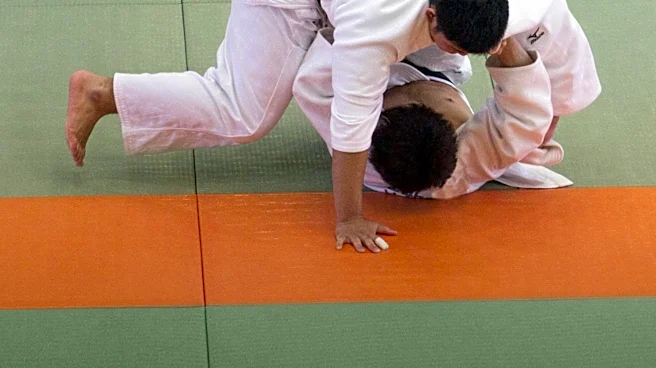
and self-defense, focusing on throws, joint locks, strikes, and weapons. Training often involves kata (pre-arranged sequences). Brazilian Jiu-Jitsu, on the other hand, evolved from Kodokan Judo, which itself was derived from Japanese Jujutsu. BJJ narrowed its focus primarily to ground fighting, emphasizing control, submissions, and live sparring (rolling) against a resisting partner. Key differences include BJJ's development of the guard as an offensive position and its 'position before submission' philosophy, while traditional Japanese Jiu-Jitsu maintains a broader self-defense syllabus that includes striking and weapon defense.
Why It's Important?
This comparison is significant for individuals in the U.S. interested in martial arts, self-defense, or fitness, as it clarifies the distinct benefits and training approaches of two seemingly similar disciplines. For those seeking practical self-defense, understanding these differences can guide their choice of martial art. BJJ's emphasis on ground control and submissions makes it highly effective in one-on-one combat, particularly against larger opponents, which has contributed to its popularity in mixed martial arts (MMA) and self-defense scenarios in the U.S. Conversely, Japanese Jiu-Jitsu offers a more comprehensive, traditional self-defense system that includes standing techniques and weapon defense. The growth of BJJ academies across the U.S., such as GMA in Gallatin, TN, reflects its widespread appeal and impact on the American fitness and martial arts landscape, offering both physical and mental health benefits.
What's Next?
Individuals considering martial arts training are encouraged to try both disciplines to determine which best aligns with their personal goals, whether it's self-defense, sport, or fitness. BJJ schools, like GMA in Gallatin, TN, often offer free trial classes to allow prospective students to experience the training firsthand. The continued evolution of both martial arts will likely see BJJ further refining its sport-specific techniques and expanding its competitive scene, while Japanese Jiu-Jitsu schools may continue to preserve and teach traditional self-defense methods. The ongoing dialogue and cross-pollination of techniques between different martial arts communities could also lead to hybrid training approaches or a deeper appreciation for the unique contributions of each discipline.
Beyond the Headlines
The evolution from Japanese Jiu-Jitsu to Brazilian Jiu-Jitsu illustrates a fascinating case study in cultural adaptation and innovation within martial arts. The shift from kata-based training to live sparring in Judo, and subsequently in BJJ, revolutionized how martial arts effectiveness is tested and developed. This emphasis on 'randori' or 'rolling' highlights a core principle: techniques must work under pressure against a resisting opponent to be truly effective. This philosophical difference has profound implications for how practitioners approach learning, self-improvement, and even conflict resolution. Furthermore, the global spread of BJJ, particularly in the U.S., reflects a broader cultural exchange and the universal appeal of disciplines that empower individuals through technique and leverage, rather than just brute strength, fostering a sense of confidence and discipline.