





What's Happening?
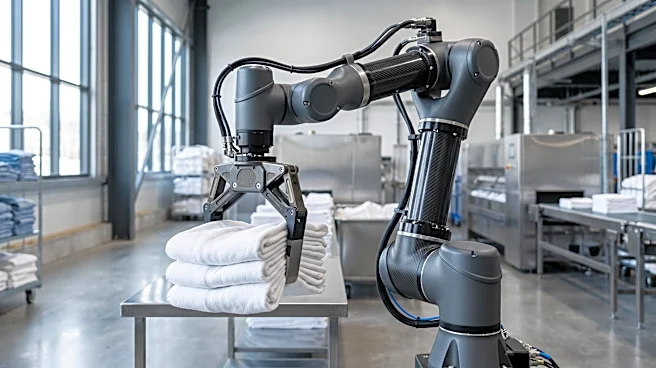
French physical AI startup Gobano Robotics has reported a 99.5% task success rate for its autonomous robotic system at Henri Wartner Group, an industrial laundry company in France. The Gobano Station robot is designed to handle repetitive towel folding
and inspection tasks, operating autonomously for several hours while human employees focus on other duties. According to Gobano, the system achieves 68% of a human worker's throughput over an 18-hour shift, with continuous improvements in productivity attributed to reinforcement learning. The robot is engineered to manage variations in towel positioning, fabric folds, and gripping conditions without constant human supervision. If a grasp fails or a towel is misplaced, the system can automatically check the outcome and restart the workflow, a recovery capability deemed essential for maintaining production without frequent human intervention. Human employees remain responsible for material replenishment, maintenance, and resolving exceptions that the robot cannot handle.
Why It's Important?
This high success rate for an autonomous laundry robot in an industrial setting holds significant implications for the U.S. service and manufacturing sectors, particularly those dealing with repetitive tasks involving flexible materials. The ability of the Gobano Station to operate autonomously for extended periods with minimal human intervention demonstrates a viable solution for improving efficiency and addressing labor challenges in industries like hospitality, healthcare, and textile manufacturing. The integration of reinforcement learning, which allows the robot to learn from production data and continuously improve its performance, represents a key advancement in AI-driven automation. This technology can lead to substantial cost savings, increased throughput, and more consistent quality in tasks that are often labor-intensive and prone to human error. For U.S. businesses, adopting such systems could enhance operational resilience, reduce reliance on manual labor for monotonous tasks, and free up human workers for more complex and value-added activities.
What's Next?
Gobano Robotics plans to extend the operating periods of its autonomous laundry robot, further increase its throughput, and develop capabilities for handling additional materials and workflows. The company also aims to transfer learning from existing installations to future robotic systems, which would reduce the time required to establish reliable autonomous operations in new deployments. As the technology matures, it is likely to be adopted by more industrial laundry facilities and potentially expanded to other sectors requiring the handling of flexible goods. This could lead to a broader market for physical AI solutions in the U.S., driving innovation in robotics and automation. The success of this early commercial application will likely encourage further investment in reinforcement learning and autonomous manipulation systems, pushing the boundaries of what robots can achieve in real-world industrial environments.
Beyond the Headlines
The deployment of the Gobano Station highlights the growing sophistication of physical AI in performing complex, real-world tasks that involve variability and require adaptive responses. The robot's ability to handle flexible materials, which has historically been a significant challenge for automation, marks a crucial milestone. The emphasis on reliability before speed, as stated by Gobano, reflects a pragmatic approach to industrial AI deployment, prioritizing consistent performance over raw throughput. This case study also underscores the evolving relationship between humans and robots in the workplace, where robots handle the repetitive and physically demanding tasks, while humans manage oversight, maintenance, and problem-solving. This collaborative model could redefine job roles and skill requirements in various industries, fostering a more efficient and potentially safer working environment.