



What's Happening?
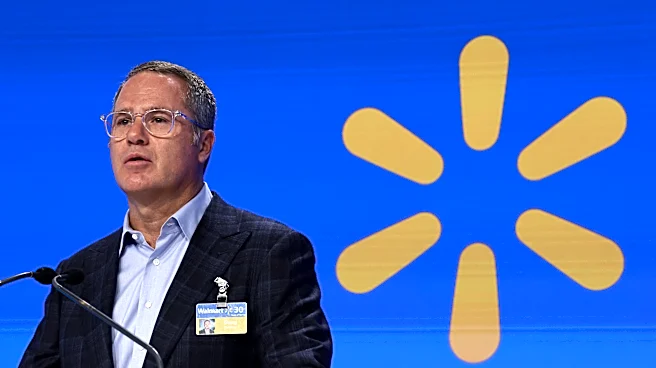
Former Walmart CEO Doug McMillon indicated that the transformative power of Artificial Intelligence (AI) played a role in his decision to step aside from his leadership position. According to The CEO Magazine, McMillon noted that while he could initiate
the next major AI transformation, he recognized he might not be the one to see it through to completion. This sentiment was echoed by Coca-Cola CEO James Quincey, who also cited AI as a factor in his decision, stating that his company required someone with the energy to pursue a new enterprise transformation. Both executives acknowledged the limits of their own capabilities in the face of rapidly evolving AI technologies, making room for new leadership better equipped to navigate this shift. The article emphasizes a transition from 'finite leadership,' which optimizes existing business models with AI, to 'infinite leadership,' which leverages AI to fundamentally redesign businesses for future relevance.
Why It's Important?
The decisions by prominent CEOs like Doug McMillon underscore a critical shift in corporate leadership paradigms driven by AI. This trend highlights that even highly successful leaders recognize the need for a different skill set to navigate the profound changes AI brings. It signals that companies prioritizing long-term survival and growth must embrace leaders who are not just technologically adept but also possess a vision for complete business reinvention rather than mere optimization. The departure of such experienced executives due to AI considerations could prompt other corporate boards to re-evaluate their leadership structures and succession plans, focusing on leaders who can drive AI-led transformation. This shift is crucial for U.S. businesses to remain competitive globally, as those that fail to adapt their leadership to the AI era risk obsolescence.
What's Next?
The trend of CEOs stepping aside due to AI's transformative impact suggests a future where leadership roles will be increasingly defined by an ability to understand, integrate, and strategically leverage AI. Companies are likely to prioritize candidates for top executive positions who demonstrate deep technical fluency, adaptability, and a willingness to challenge established business orthodoxies. This could lead to a greater emphasis on continuous learning and upskilling for current executives, as well as a re-evaluation of traditional leadership development programs. Boards may also begin to incorporate AI readiness as a key criterion in executive performance reviews and succession planning. Furthermore, the focus will shift from simply implementing AI as a technological tool to integrating it as a core component of business strategy and organizational culture, requiring leaders who can champion this holistic transformation.
Beyond the Headlines
The decisions by McMillon and Quincey reveal a deeper implication: the very definition of effective leadership is being reshaped by AI. It challenges the traditional view of a CEO as solely a financial synthesizer and strategic decision-maker, pushing towards a model where leaders must also be technological visionaries and cultural architects. This evolution raises ethical questions about the responsibility of leaders to not only drive technological advancement but also to manage its societal and workforce impacts. The concept of 'infinite leadership' suggests a continuous state of adaptation and reinvention, implying that leaders must foster a culture of perpetual learning and innovation within their organizations. This shift could lead to a re-evaluation of corporate governance, with boards potentially seeking more diverse expertise, including AI specialists, to guide companies through this era of rapid technological change.