


What's Happening?
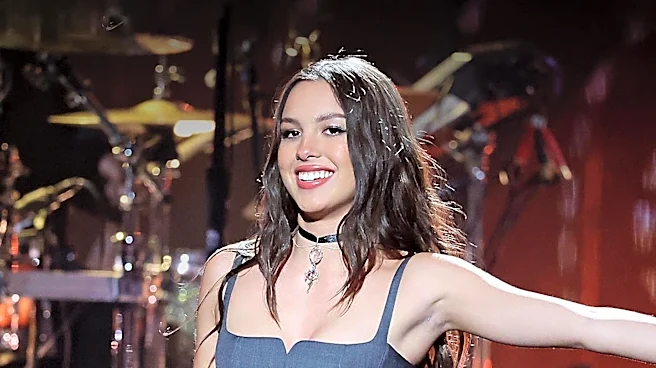
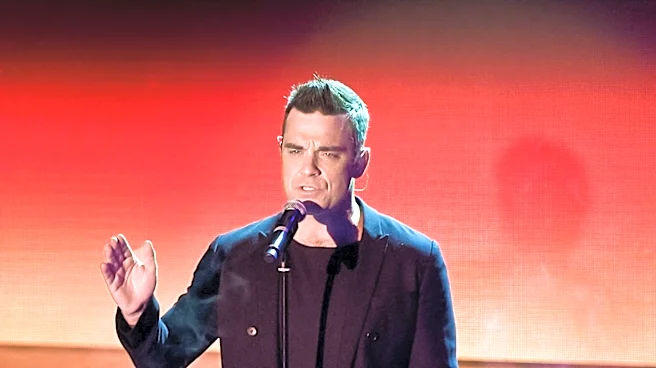
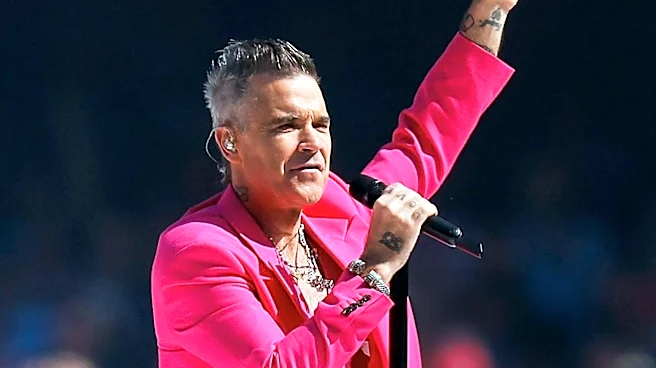
Singer Robbie Williams has responded to claims that Olivia Rodrigo's song 'Take Me Home (4 Christmas)' sounds similar to his 2012 hit 'Candy.' Williams issued a statement on Instagram, expressing his admiration for Rodrigo and stating that he believes
she may have 'accidentally stumbled across a musical echo' of his song. He explicitly said, 'I couldn’t care less' about potential publishing or copyright issues and affirmed he would not pursue legal action. Williams emphasized that there are a finite number of musical chords and notes, making it inevitable for artists to occasionally create something similar to existing works. He distinguished between genuine theft and accidental similarities, arguing that excessive punishment for such occurrences could stifle creativity. Williams concluded his statement with a direct message to Rodrigo, calling her 'brilliant' and jokingly asking her to reduce her on-stage swearing.
Why It's Important?
Robbie Williams's public stance on the alleged song similarity is significant for the music industry, particularly in an era marked by frequent copyright disputes. His comments advocate for artistic freedom and a more understanding approach to musical coincidences, acknowledging the limited pool of musical elements available to creators. This perspective could influence how artists, labels, and legal teams approach future claims of similarity, potentially fostering a less litigious environment and encouraging more creative experimentation without fear of immediate legal repercussions. It also highlights the subjective nature of musical inspiration and the fine line between influence and infringement.
What's Next?
Williams's statement is likely to be well-received by artists and fans who advocate for creative freedom. It may encourage other established artists to adopt a similar conciliatory approach when faced with claims of musical similarity, potentially setting a precedent for resolving such issues outside of court. The incident could also spark further discussion within the music industry about the criteria for copyright infringement and the balance between protecting intellectual property and fostering a vibrant creative landscape. Olivia Rodrigo's team has not yet publicly responded to Williams's statement, but his comments may alleviate any pressure on her regarding the claims.
Beyond the Headlines
This incident and Robbie Williams's response delve into the philosophical underpinnings of creativity and originality in art. His argument that artists 'inevitably find (themselves) somewhere somebody else has been' speaks to the collective unconscious of artistic creation and the iterative nature of cultural production. It raises questions about what truly constitutes 'originality' in a world where all art builds upon previous forms and ideas. Williams's call for 'sanity' in copyright discussions suggests a desire to protect the creative process itself from becoming overly constrained by legalistic interpretations, emphasizing the importance of inspiration and evolution over strict adherence to novelty.