





What's Happening?
Traditional load-carrying methods from various cultures, such as the furoshiki from Japan, the bilum from Papua New Guinea, the namlo and doko system from the Himalayas, the gaucho's rastra and sash from South America, and head-carrying techniques in Africa,
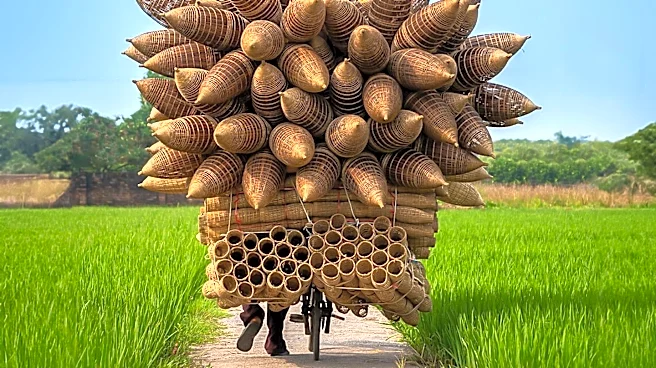
demonstrate principles of minimalism and collaboration with nature. These methods often utilize minimal hardware, focusing instead on adaptability, ergonomics, and integrating the load with the body's natural movements. For instance, the furoshiki, a simple square of cloth, can transform into various carrying solutions without hardware. The bilum, a looped net bag, adapts to its contents and distributes weight through a forehead strap. The namlo and doko system aligns the load with the carrier's center of gravity, using posture to balance weight. African head-carrying, particularly among highly trained individuals, shows remarkable efficiency by transforming the load into an extension of natural gait, reducing metabolic cost.
Why It's Important?
The insights from these traditional load-carrying systems offer valuable lessons for modern design and engineering, particularly in the context of sustainability and human efficiency. By demonstrating how complex problems can be solved with minimal resources and in harmony with natural principles, these methods challenge the modern reliance on specialized, hardware-intensive solutions. The 'free ride' effect observed in head-carrying, where trained individuals expend minimal additional energy, highlights the potential for optimizing human biomechanics in load transport. This could influence the design of future ergonomic equipment, focusing on integration with the body rather than isolation. Furthermore, the use of locally available, repairable materials in many traditional systems provides a model for sustainable practices, reducing waste and promoting resourcefulness in an era of increasing environmental concern. These approaches emphasize a holistic view of carrying, where the system shapes movement and disappears into the rhythm of the person, rather than acting as an independent machine.
What's Next?
The principles observed in traditional load-carrying methods could inspire new approaches in modern product design, particularly in outdoor gear, ergonomics, and sustainable manufacturing. Researchers and designers may further investigate the biomechanics of these traditional techniques to develop more efficient and body-friendly carrying solutions. There could be a renewed interest in using natural and locally sourced materials, promoting repairability and longevity in products. Educational initiatives might emerge to teach these 'lost arts' of carrying, not just for historical preservation but for practical application in contexts where resourcefulness and efficiency are paramount. The broader cultural impact could involve a shift in consumer values, prioritizing simplicity, durability, and environmental consciousness over feature-rich, disposable products. This re-evaluation could lead to a more mindful approach to consumption and design, drawing inspiration from centuries of human ingenuity.
Beyond the Headlines
Beyond their practical applications, these traditional carrying methods offer a deeper philosophical perspective on humanity's relationship with its environment and resources. They embody a profound understanding of natural laws and human capabilities, developed through generations of intimate interaction with diverse landscapes. The emphasis on collaboration with nature, rather than resistance, suggests a different paradigm for technological advancement—one that seeks synergy rather than dominance. These practices also highlight the cultural significance of everyday objects and activities, where carrying a load is not merely a functional task but an integrated part of identity, community, and survival. The 'lost art' of carrying loads serves as a reminder that some of the most elegant and effective solutions often arise from simplicity, deep observation, and a respectful engagement with the world around us, offering a counter-narrative to the relentless pursuit of complex, high-tech solutions.