




What's Happening?
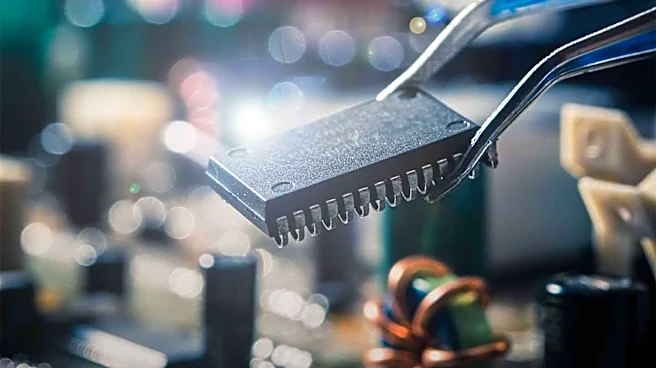
Lumissil Microsystems has launched the IS31FL3713, a new 4x3 matrix LED driver designed to power up to 12 individual LEDs or 4 RGB LEDs. This device features an integrated synchronous boost converter operating at 1MHz, which allows for the use of a small
1µH inductor, minimizing the application's form factor. The IS31FL3713 operates within a 2.2V to 5.5V supply range and is available in a compact WLCSP-12 package. A key innovation is its ability to significantly extend battery life in portable devices by addressing the power consumption of LED indicators. It achieves this through an ultra-low operational current of 1.1mA (typical), a 0.3µA hardware shutdown current, and time-multiplexed matrix operation. The integrated DC-DC boost converter eliminates the need for an external conversion stage, and its output voltage is register-programmable from 3.0V to 5.0V in 100mV steps, allowing for precise matching to LED forward voltage and reduced power dissipation. The driver also offers selectable scan modes (4x3, 3x3, 2x2, 1x3, and direct drive (4Ch)) to scale the number of LEDs used for specific applications.
Why It's Important?
The introduction of the IS31FL3713 by Lumissil Microsystems is significant for the U.S. technology and consumer electronics industries, particularly in the growing markets for hand-held, wearable, and IoT devices. Battery life is a critical factor for consumer satisfaction and product competitiveness in these sectors. By offering an LED driver that drastically reduces power consumption from LED indicators, Lumissil Microsystems enables manufacturers to design devices with longer operational times, a key differentiator in a crowded market. This advancement can lead to more efficient and user-friendly products, potentially boosting sales and market share for companies that adopt this technology. Furthermore, the compact size and integrated features of the IS31FL3713 simplify design processes and reduce the bill of materials for manufacturers, contributing to cost savings and faster time-to-market for new products. The ability to precisely control LED power and animation with minimal MCU intervention also frees up processing power for other functions, enhancing overall device performance and user experience.
What's Next?
The IS31FL3713 is currently available in a compact WLCSP-12 package and is specified for operation across an industrial temperature range of -40°C to +125°C. The ordering part number is IS31FL3713-CLS4-TR, and it is supplied in reels of 3,000 units. Manufacturers of hand-held, wearable, and IoT applications are expected to begin integrating this new LED driver into their product designs. This could lead to a new generation of devices with improved battery performance and more sophisticated LED-driven user interfaces. Lumissil Microsystems, with its global presence and specialization in analog/mixed-signal products, will likely focus on promoting the adoption of the IS31FL3713 across its target markets, including automotive, communications, industrial, and consumer sectors. The company's continued innovation in LED driver technology suggests further advancements aimed at optimizing power efficiency and functionality in various electronic applications.
Beyond the Headlines
Beyond the immediate technical specifications, the IS31FL3713 represents a broader trend in the electronics industry towards greater energy efficiency and miniaturization. As devices become smaller and more integrated into daily life, the demand for components that can deliver high performance with minimal power draw intensifies. This LED driver's autonomous animation engine, which stores up to 12 independent patterns and executes them with a single I2C command, highlights a shift towards more intelligent and self-sufficient components. This reduces the processing load on the main microcontroller, allowing for more complex functionalities or further power savings. The emphasis on individual open/short detection with fault registers and a de-ghost function also points to an increasing focus on reliability and diagnostic capabilities in compact electronic systems. These advancements are crucial for the long-term viability and widespread adoption of IoT and wearable technologies, where device longevity and consistent performance are paramount.