






What's Happening?
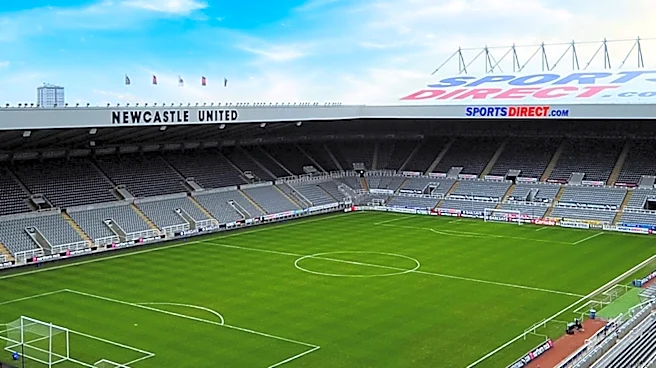
Stefan Borson, a former financial adviser for Manchester City, suggests that Saudi Arabia's Public Investment Fund (PIF) might include plans for a new Newcastle United stadium in the club's potential future sale price. While supporters view the stadium plans as a sign
of PIF's long-term commitment to Newcastle, Borson warns that this could indicate the opposite. He explains that PIF might be preparing the groundwork, such as securing planning permission for a 'super stadium' at Leazes Park, to increase the club's value before 'flipping' the project to new owners. The estimated cost for a new stadium could exceed £1.3 billion, a significant investment that future owners would then undertake.
Why It's Important?
This development is significant for the future of Newcastle United and its fanbase, as it challenges the perception of PIF's long-term involvement. If PIF's strategy is to prepare the club for a sale by adding value through stadium plans rather than executing the construction themselves, it could lead to uncertainty for supporters who anticipate sustained investment. For potential buyers, this approach means acquiring a club with pre-approved, high-value development plans, but also inheriting a substantial financial commitment for construction. This strategy could set a precedent in sports club acquisitions, where current owners invest in pre-development stages to maximize sale value without bearing the full construction costs.
What's Next?
The immediate next steps involve the progression of the stadium plans, including securing all necessary planning permissions and addressing any remaining concerns, such as those related to animal and plant welfare at Leazes Park. While these plans are currently conceptual, their advancement will be closely watched by Newcastle United fans and potential investors. Should PIF proceed with this strategy, future discussions around the club's ownership will likely factor in the stadium project's status and its associated costs. The actual construction of a new stadium would then fall to subsequent owners, who would need to allocate significant capital for the estimated multi-billion-pound project.
Beyond the Headlines
The potential strategy of PIF to 'flip' the stadium project highlights a broader trend in commercial property and sports club ownership, where value is created through strategic planning and approvals rather than direct execution of large-scale developments. This approach allows investors to capitalize on the increased valuation derived from development potential, transferring the capital-intensive construction phase to a subsequent owner. For sports clubs, this could mean a more transactional ownership model, where clubs are seen as assets to be optimized and traded, potentially impacting the emotional connection between owners and the fanbase. It also raises questions about the long-term vision for club development versus short-to-medium term financial gains.