


What's Happening?
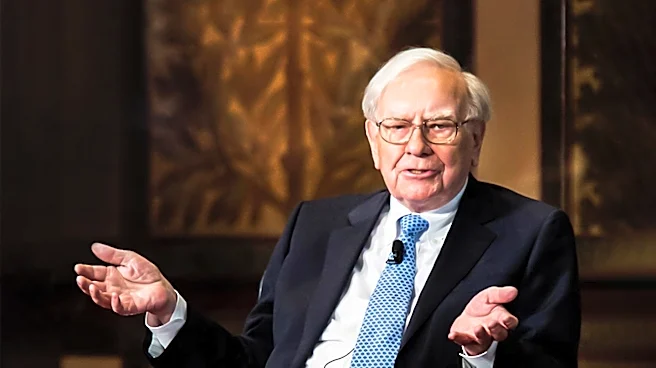
Greg Abel, CEO of Berkshire Hathaway, has continued the company's strategy of significant share buybacks, spending $9.6 billion on Berkshire Hathaway stock during the third quarter of 2026. This move aligns with the practices of his predecessor, Warren
Buffett, who stepped down as CEO earlier this year. Buffett had a long-standing preference for repurchasing Berkshire Hathaway stock, having spent approximately $92 billion on buybacks since 2018, significantly more than the roughly $36 billion invested in Apple stock between 2016 and 2018. Abel's decision to continue this strategy signals a commitment to maintaining the company's established values and culture. The buybacks are seen as an indication of management's confidence that Berkshire Hathaway's shares are undervalued relative to its intrinsic worth and future growth potential, a core tenet of Buffett's investment philosophy.
Why It's Important?
This substantial investment in share buybacks by Berkshire Hathaway under Greg Abel's leadership is significant for several reasons. Firstly, it reassures investors that the company's strategic direction remains consistent with the principles established by Warren Buffett, emphasizing long-term value creation. Share buybacks, when executed when a stock is undervalued, can increase the intrinsic value per share for existing shareholders, demonstrating management's belief in the company's future. Secondly, it reflects a broader corporate strategy that prioritizes returning capital to shareholders through means other than dividends, which Berkshire Hathaway typically avoids. This move also signals confidence in the company's diverse portfolio and its ability to navigate various economic conditions. For the market, it reinforces the idea that even large, established conglomerates see value in their own stock, potentially influencing other companies' capital allocation decisions.
What's Next?
Berkshire Hathaway is expected to continue its share buyback program as long as management believes the stock is trading below its intrinsic value. This strategy, deeply ingrained in the company's culture, will likely remain a key component of its capital allocation under Greg Abel. Investors will closely monitor future quarterly reports for further buyback activity, which will serve as an ongoing indicator of management's confidence in the company's valuation and prospects. The continuation of this policy suggests that Berkshire Hathaway will prioritize enhancing shareholder value through reduced share count, rather than through dividends or aggressive external acquisitions, unless compelling opportunities arise. This consistent approach provides a degree of predictability for investors in an otherwise dynamic market environment.
Beyond the Headlines
The continuation of Berkshire Hathaway's aggressive share buyback program under Greg Abel speaks to a deeper philosophical commitment to value investing and capital discipline. In an era where many companies prioritize growth at all costs or succumb to short-term market pressures, Berkshire's steadfast focus on intrinsic value and returning capital through buybacks stands out. This approach implicitly critiques market inefficiencies, suggesting that even a company as large and diversified as Berkshire Hathaway can find its own shares to be the most attractive investment. It also highlights the enduring influence of Warren Buffett's investment principles, demonstrating how a strong corporate culture and philosophy can persist through leadership transitions. This strategy serves as a practical lesson in long-term investing, emphasizing patience and a deep understanding of a company's true worth over speculative trends.