







What's Happening?
IonQ, a quantum computing company, has partnered with the University of Cambridge to establish the first university-based Quantum Innovation Centre. This new center will facilitate joint research projects across various fields, including finance, engineering,
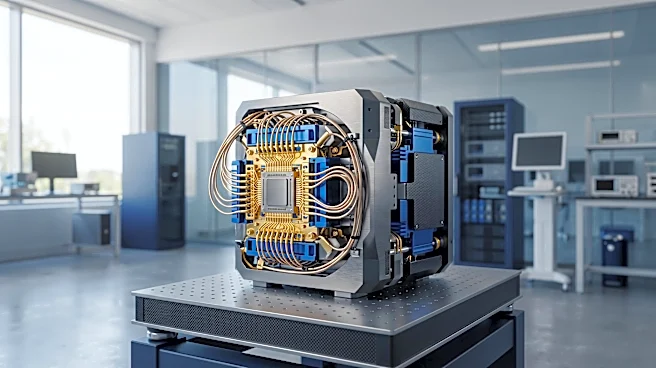
and medicine, utilizing IonQ's quantum systems. IonQ hardware and new quantum network infrastructure are being deployed directly on the Cambridge campus, providing researchers with immediate access to the company's latest quantum machines. The initiative aims to bridge the gap between theoretical quantum computing concepts and real-world applications, allowing end-users to test practical workloads on advanced quantum hardware. This collaboration is a significant step in IonQ's strategy to build a comprehensive quantum platform encompassing computing, networking, sensing, and security.
Why It's Important?
The establishment of the Quantum Innovation Centre is crucial for the advancement of quantum computing in the U.S. and globally. By placing advanced quantum hardware directly within a major research hub like Cambridge, IonQ is enabling practical testing and development of quantum applications in critical sectors such as finance, medicine, and materials science. This direct access can accelerate the identification of viable use cases and the development of quantum algorithms, potentially leading to breakthroughs that could revolutionize these industries. For U.S. businesses and researchers, this collaboration signifies a move towards more accessible and applicable quantum technology, fostering innovation and potentially creating new economic opportunities. The center's success could also influence future investment and research directions in quantum computing, impacting the competitive landscape of the technology sector.
What's Next?
The immediate next steps for the Quantum Innovation Centre involve the full commissioning of the on-campus Superion 256 qubit machine and quantum network nodes. Following this, the focus will shift to how quickly the Cambridge activities translate into identifiable usage and contracts. This could include disclosed ion trap system deals, network projects linked to the strengthened Cambridge to Bristol connection, and formal updates on research outcomes. Investors will be closely monitoring whether IonQ can effectively convert its technology roadmap into tangible real-world workloads. The center is expected to drive nine targeted research projects, aligning with the broader roadmap for quantum networking, government-backed programs, and semiconductor-style manufacturability. The practical test will be the speed at which these research efforts yield concrete results and commercial applications.
Beyond the Headlines
Beyond the immediate technical and commercial implications, the Quantum Innovation Centre represents a deeper shift in how advanced technologies are developed and integrated into society. By embedding quantum hardware within a university setting, it fosters a collaborative ecosystem where academic research meets industrial application. This model could become a blueprint for future technology development, promoting interdisciplinary collaboration and accelerating the transition of cutting-edge science from laboratories to practical tools. Ethically, the development of quantum computing raises questions about data security, privacy, and the potential for disruptive societal changes, which will need to be addressed as the technology matures. Culturally, it signifies a growing recognition of quantum computing's potential to reshape various aspects of human endeavor, from drug discovery to financial modeling, pushing the boundaries of what is computationally possible.