




What's Happening?
GE Vernova has announced significant advancements in its hydrogen-ready aeroderivative gas turbine technology. The company has validated its LM2500XPRESS package to operate with fuel blends containing up to 50% hydrogen in a Dry Low Emission (DLE) configuration.
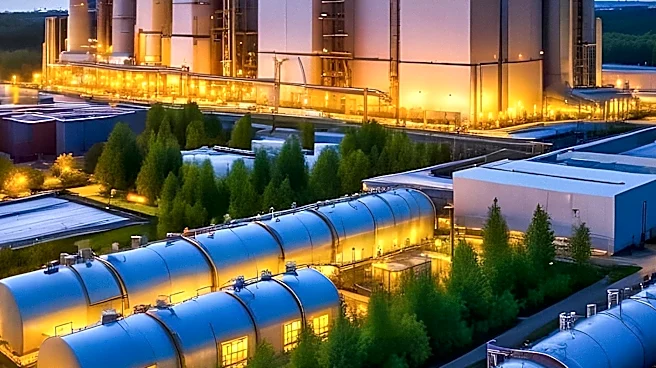
Additionally, GE Vernova successfully completed testing to demonstrate the 100% hydrogen capability of its LM6000 platform using a Single Annular Combustor (SAC) configuration. These milestones were achieved at GE Vernova's dedicated hydrogen testing facility in Greenville, South Carolina. The company has accumulated over 11 million operating hours using hydrogen and hydrogen-blended fuels across its global gas turbine fleet, with more than 120 GE Vernova gas turbines having operated or continuing to operate on such fuels. Cecilia Giovannelli, CEO of GE Vernova's Gas Power Aeroderivative gas turbine business, emphasized that these developments are crucial steps in accelerating the energy transition by providing hydrogen-ready solutions that enable customers to reduce carbon emissions while maintaining grid stability.
Why It's Important?
These technological advancements by GE Vernova are important for the U.S. energy sector and global efforts towards decarbonization. The ability of gas turbines to operate with higher concentrations of hydrogen, including 100% hydrogen, provides a pathway for industries and utilities to transition to lower-carbon energy systems without compromising reliability. Hydrogen-ready gas turbines are particularly vital for sectors requiring continuous and reliable power generation. The LM2500XPRESS, with its rapid-start capabilities, is suitable for applications like industrial cogeneration, district heating, data centers, and grid support, offering flexibility to respond to electricity demand fluctuations. The expansion of hydrogen combustion capabilities across GE Vernova's gas turbine portfolio, including its HA-class gas turbines, signifies a broader shift in the energy landscape. This development supports the U.S. in achieving its climate goals by enabling the use of cleaner fuels for electricity generation and industrial applications, such as steelmaking, refining, and petrochemicals. The investment in U.S. manufacturing and technology capabilities, as evidenced by the Greenville testing facility, also strengthens domestic innovation in clean energy.
What's Next?
The successful validation and testing of GE Vernova's hydrogen-ready gas turbines are expected to accelerate the adoption of hydrogen as a fuel source in power generation. Operators now have a clearer path to introduce hydrogen blending into existing or new power generation infrastructure, potentially reaching 100% hydrogen operation with appropriate system upgrades. The company's integrated testing center in Greenville will continue to support the development and validation of advanced turbine technologies, reducing lead times and strengthening technical support for customers globally. This will likely lead to more widespread commercial deployment of these hydrogen-capable turbines. The ongoing expansion of hydrogen combustion capabilities across GE Vernova's heavy-duty gas turbine portfolio suggests a future where hydrogen plays a more prominent role in various industrial and power generation applications. As lower-carbon fuels become increasingly available, these technologies will enable industries to reduce carbon emissions while maintaining operational flexibility.
Beyond the Headlines
The implications of GE Vernova's advancements extend beyond immediate energy production. The development of robust hydrogen combustion technology addresses significant engineering challenges associated with hydrogen's unique combustion characteristics, paving the way for broader industrial applications. This progress could catalyze further investment in hydrogen production, storage, and distribution infrastructure, creating new economic opportunities and supply chains. Ethically, this technology supports the global imperative to mitigate climate change by offering a viable path to decarbonize hard-to-abate sectors. Culturally, it signifies a shift towards a more sustainable energy paradigm, potentially influencing public perception and policy support for hydrogen as a clean energy solution. The long-term shift could see hydrogen becoming a cornerstone of a diversified energy mix, reducing reliance on fossil fuels and fostering energy independence for nations that can produce hydrogen efficiently.