






What's Happening?
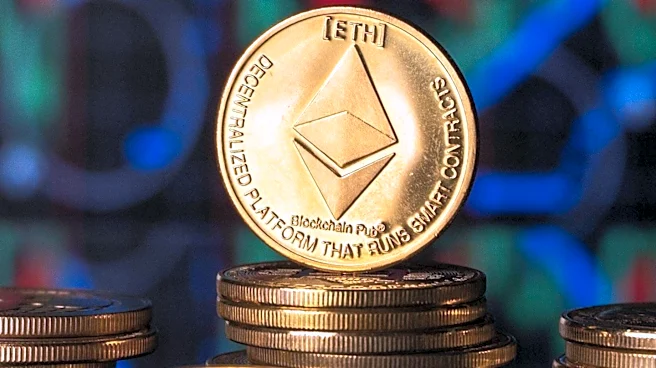
BitMine, a company chaired by Tom Lee, has significantly increased its Ethereum (ETH) holdings, purchasing an additional 7,819 ETH last week. This acquisition brings their total Ethereum treasury to over 6 million tokens, representing 4.98% of Ethereum's
total supply. Despite a broader cryptocurrency market downturn, Lee, who is also a co-founder of Fundstrat, is making a 'hard money' case for Ethereum, comparing its supply growth rate to that of Bitcoin. He argues that both cryptocurrencies exhibit slow and predictable supply growth, which is a characteristic of 'hard money' assets designed to preserve value over time. Lee points to data showing Ethereum's supply has grown 1.26% since June 30, 2025, or approximately 0.9% annually, which is comparable to Bitcoin's annual supply growth of about 0.82%.
Why It's Important?
This move by BitMine and Tom Lee's public endorsement of Ethereum as 'hard money' could significantly influence investor perception and potentially stabilize or boost confidence in ETH, especially during a volatile crypto market. Lee's comparison of Ethereum to Bitcoin in terms of supply growth challenges conventional views that often place Bitcoin as the sole 'digital gold.' If more institutional investors adopt this perspective, it could lead to increased demand and investment in Ethereum, potentially driving its price upward and enhancing its long-term viability as a store of value. For the broader cryptocurrency market, this argument could encourage a re-evaluation of other digital assets based on their supply dynamics, potentially shifting investment strategies and fostering a more mature understanding of crypto valuations beyond speculative trading.
What's Next?
The cryptocurrency market will likely observe how BitMine's substantial Ethereum holdings perform and whether Lee's 'hard money' thesis gains wider acceptance among financial analysts and institutional investors. Continued accumulation of ETH by major players like BitMine could signal a growing trend of institutional adoption, potentially leading to more regulated investment products and increased liquidity for Ethereum. The market's reaction to Lee's comparison of ETH and BTC's inflation rates will be crucial, as it could either validate or challenge the prevailing narrative around Bitcoin's unique position. Future supply data for Ethereum and Bitcoin will be closely monitored to see if the observed growth rates remain consistent, further supporting or refuting Lee's argument.
Beyond the Headlines
Tom Lee's 'hard money' argument for Ethereum delves into fundamental economic principles applied to digital assets, suggesting a maturation of the cryptocurrency market beyond speculative trading. By focusing on predictable supply growth, Lee is attempting to frame Ethereum as a long-term asset, similar to traditional commodities like gold. This perspective could have profound implications for how central banks and financial institutions view and potentially integrate cryptocurrencies into their portfolios. It also raises questions about the future of monetary policy in a world where decentralized digital assets with controlled supply could offer an alternative to fiat currencies. The ethical and regulatory implications of such a shift, particularly concerning market manipulation and investor protection, will become increasingly relevant as these assets gain mainstream acceptance.