






What's Happening?
Philadelphia Eagles head coach Nick Sirianni has decided to maintain personal control over throwing the challenge flag during games, despite a new NFL rule for the 2026 season that allows head coaches to designate a staff member for this responsibility.
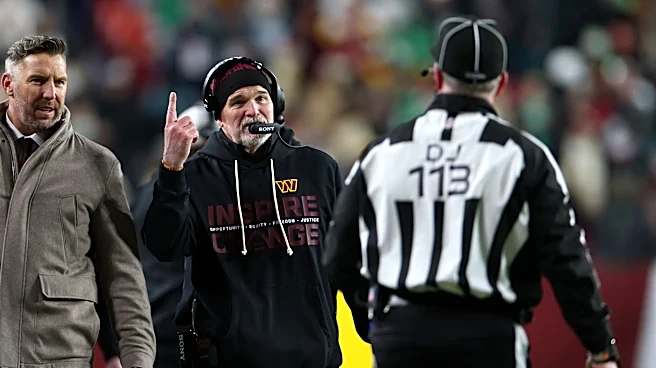
The rule change, a summer clarification that did not require an owners' vote, permits a pre-game designated staff member to initiate a challenge by throwing a red flag. This adjustment aims to alleviate game-day burdens for coaches, particularly those heavily involved in play-calling. Sirianni, however, expressed his intention to keep this duty, emphasizing the need for direct communication and quick action in critical moments. He cited a 2022 game against Washington where the Eagles successfully beat a challenge due to swift action, highlighting the importance of split-second timing. Other 'CEO coaches' like Dan Campbell and Mike Vrabel also align with Sirianni's stance, prioritizing accountability and communication.
Why It's Important?
Sirianni's decision underscores a philosophical divide among NFL head coaches regarding game management and delegation. While the NFL introduced the rule to potentially free up mental bandwidth for play-calling coaches, Sirianni's choice reflects a belief that certain critical, time-sensitive decisions, like challenging a play, require the head coach's direct involvement. This approach could impact game outcomes, as a timely and accurate challenge can swing momentum or overturn crucial calls. For the Eagles, it means Sirianni will continue to be the sole decision-maker for challenges on the field, potentially influencing the team's strategic flexibility during high-pressure situations. The continuity of his personal involvement in this aspect of game management could be seen as a commitment to direct oversight, but also as a potential distraction from other in-game responsibilities, depending on the coach's capacity to multitask effectively under pressure.
What's Next?
The 2026 NFL season will serve as a practical test for how different coaching philosophies regarding the challenge flag rule play out. While Sirianni and other coaches have publicly stated their intentions, the actual in-game scenarios will reveal the efficacy of their choices. Teams whose coaches delegate the responsibility will be observed to see if it truly enhances their focus on play-calling and overall game strategy. Conversely, teams like the Eagles, where the head coach retains the duty, will be scrutinized for their challenge success rates and whether the decision impacts other aspects of their game management. The league and individual teams will likely evaluate the impact of this rule change throughout the season, potentially leading to further discussions or adjustments in future seasons based on observed outcomes and coaching preferences.
Beyond the Headlines
Sirianni's decision to retain the challenge flag responsibility touches upon broader themes of leadership, control, and trust within high-stakes professional environments. In a league where every second and every decision can have significant financial and competitive consequences, the willingness to delegate or centralize authority speaks volumes about a coach's leadership style. Sirianni's emphasis on direct communication and quick action suggests a preference for hands-on control in critical moments, potentially reflecting a belief that certain responsibilities cannot be effectively outsourced without compromising precision or timing. This approach could foster a culture of direct accountability within the Eagles organization, but it also places a significant burden on the head coach to manage multiple complex tasks simultaneously under immense pressure. The ongoing debate among coaches about this rule highlights the intricate balance between delegation for efficiency and centralized control for perceived accuracy in professional sports.