
What's Happening?
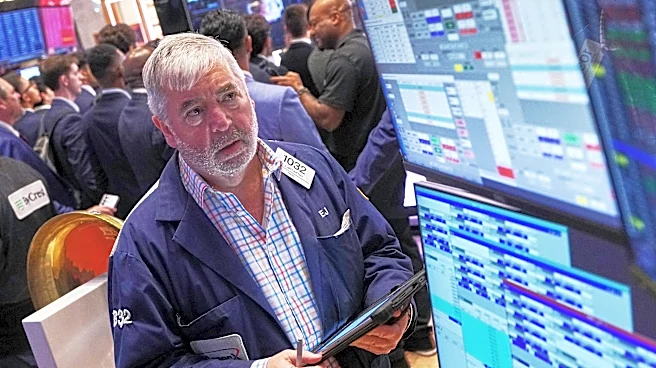
The semiconductor industry, particularly AI hardware stocks, has experienced significant volatility recently. Analysts from major financial institutions like Bank of America and UBS are advising investors
to remain committed to AI hardware stocks despite recent market fluctuations. The volatility has been attributed to profit-taking after substantial gains, competition from Chinese AI models, and uncertainties in interest rate outlooks. Notably, the release of China's Kimi K3 AI model by Moonshoot AI has intensified competition, causing a temporary dip in chip stocks. However, analysts argue that the AI market remains robust, with open-source models like Kimi K3 potentially increasing demand for chips. They emphasize that while competition from foreign AI developers may impact demand from U.S. labs, it is unlikely to lead to an oversupply of high-end GPUs.
Why It's Important?
The advice from analysts to stick with AI hardware stocks highlights the strategic importance of the AI sector in the global economy. The ongoing competition, particularly from Chinese AI models, underscores the geopolitical dimensions of technology development. For U.S. investors and companies, maintaining a foothold in AI hardware is crucial as it represents a significant growth area with potential long-term benefits. The continued investment in AI hardware, despite short-term financial returns, reflects the industry's view of AI as a critical competitive frontier. This situation could lead to increased innovation and expansion in the semiconductor industry, benefiting companies that can adapt to the evolving market demands.
What's Next?
As the AI hardware market continues to evolve, investors and companies will likely focus on strategic investments to maintain competitiveness. The introduction of new AI models, such as Kimi K3, may prompt U.S. companies to accelerate their development efforts to keep pace with international competitors. Additionally, the potential for increased demand for chips could drive further investment in manufacturing capacity and technological advancements. Stakeholders will be closely monitoring the market for signs of stabilization and opportunities for growth, particularly as new AI applications emerge and expand the market for AI hardware.