




What's Happening?
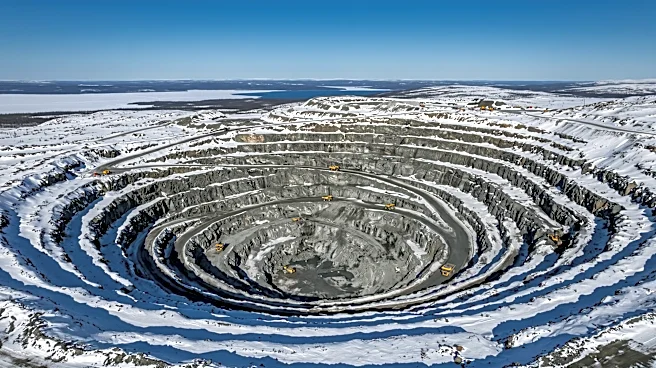
Mountain Province Diamonds Inc. has announced a comprehensive restructuring agreement with De Beers Canada Inc., Dunebridge Worldwide Ltd., and the beneficial holders of its senior secured lien notes. This agreement involves De Beers assuming full ownership
of the Gahcho Kué diamond mine (GK Mine) in the Northwest Territories, taking over Mountain Province's 49% participating interest. This transfer satisfies Mountain Province's remaining reclamation payments and other debts owed to De Beers under previous agreements. The restructuring aims to strengthen Mountain Province's financial position following a significant decline in diamond prices over the past year, attributed to tariff-related uncertainty and the conflict in the Middle East. The deal releases Mountain Province and its subsidiaries from outstanding indebtedness to De Beers and terminates related agreements. Jonathan Comerford, President and CEO of Mountain Province, stated that this is the most credible path to protect stakeholder value, remove liabilities, and provide certainty for employees and communities connected to the mine. The Noteholders and Dunebridge have also agreed to a six-month suspension of interest and capital repayments, allowing Mountain Province time to restructure its balance sheet and seek new funding.
Why It's Important?
This restructuring agreement is significant for the U.S. diamond industry and related financial markets, as it reflects the broader impact of global economic and geopolitical factors on commodity prices. The decline in diamond prices, driven by tariff uncertainties and international conflicts, highlights the vulnerability of mining companies to external market forces. For Mountain Province Diamonds, the agreement provides a critical lifeline, preventing potential financial distress by eliminating substantial debt and reclamation liabilities. This move could stabilize the company, allowing it to focus on future opportunities, particularly if diamond market conditions improve. For De Beers, gaining full ownership of the Gahcho Kué mine consolidates its position in the diamond mining sector, potentially enhancing its control over supply and pricing. The preservation of Mountain Province's rights to regain an ownership interest in the future, along with its continued control over surrounding mineral claims, suggests a strategic long-term play for both entities, indicating that while immediate financial pressures are being addressed, future collaboration or re-engagement remains a possibility.
What's Next?
Following the completion of the transaction, De Beers will become the sole owner of the GK Mine, holding 100% of the participating interest. Mountain Province and its subsidiaries will be unconditionally released from all outstanding indebtedness to De Beers. The company will use the six-month suspension of repayments from Noteholders and Dunebridge to restructure its balance sheet and pursue new funding. This funding could support the future exercise of Mountain Province's rights related to Gahcho Kué and the continued development of its Kennady diamonds assets, particularly if diamond market conditions improve. The Restructuring Agreement also grants JVCo, a wholly-owned subsidiary of Mountain Province, a right of first offer and right of first refusal (ROFO/ROFR) to acquire the GK Mine or its mineral rights if De Beers decides to sell them. Additionally, JVCo has an option to purchase the MPV Participating Interest from De Beers at any time before December 31, 2029, for a price equivalent to the share of Decommissioning Costs attributable to that interest. These provisions indicate a potential future re-entry for Mountain Province into the GK Mine's ownership.
Beyond the Headlines
The restructuring of Mountain Province Diamonds Inc. underscores the intricate relationship between global economic stability, geopolitical events, and the commodity markets. The mention of 'tariff-related uncertainty and the conflict in the Middle East' as primary drivers for the decline in diamond prices highlights how international trade policies and regional conflicts can have far-reaching consequences on seemingly unrelated industries. This situation also brings to light the significant environmental liabilities associated with mining operations, as the assumption of 'Decommissioning Costs' by De Beers is a central component of the agreement. This aspect emphasizes the growing importance of environmental responsibility and the financial burden it places on mining companies. Furthermore, the inclusion of ROFO/ROFR and option clauses in the agreement suggests a sophisticated approach to managing risk and preserving future opportunities, reflecting a strategic long-term perspective in an inherently volatile industry. It illustrates how companies navigate financial distress not just by divesting assets but by structuring deals that allow for potential future re-engagement under more favorable market conditions.