





What's Happening?
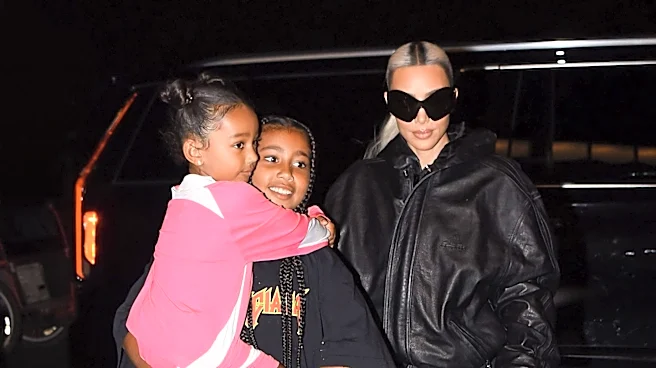
Kris Jenner has voiced strong disapproval regarding a passage in her daughter Kim Kardashian's authorized biography, 'Citizen Kim: The Woman Who Created the Future,' written by Jonathan Van Meter. The controversial line suggests that Kim may have experienced
childhood trauma despite her assertions of a happy upbringing, stating she 'just doesn’t see it.' During a recent episode of 'The Kardashians,' Kris Jenner confronted Kim, expressing that she felt 'insulted' by the author's interpretation. Jenner argued that the suggestion was a direct criticism of her parenting and the childhood she provided for her children. She demanded that Kim request the removal of the passage from the book, emphasizing her efforts to ensure her children had a trauma-free upbringing. Kim Kardashian, while intrigued by the author's perspective that her positive memories might be a coping mechanism, agreed to convey her mother's objections to Van Meter. This incident is not the first point of contention for Kris Jenner regarding the biography, as she previously expressed discomfort with the extent of private family history included in the book and the mention of her past affair.
Why It's Important?
This disagreement highlights the complexities of public figures authorizing biographies and the potential for conflict when personal narratives are interpreted by external authors. For the Kardashian-Jenner family, whose lives are extensively documented and often scrutinized, the control over their personal story is a significant aspect of their public image. Kris Jenner's strong reaction underscores the importance she places on her legacy as a mother and her perception of her children's upbringing. The incident also brings to light the tension between an author's journalistic independence and a subject's desire to control their narrative, even in an authorized biography. The public nature of this dispute, playing out on their reality television show, further blurs the lines between personal and public life, potentially influencing how other public figures approach similar biographical projects. The controversy could also spark broader discussions about the nature of memory, trauma, and how personal histories are constructed and perceived.
What's Next?
Following Kris Jenner's demand, Kim Kardashian has agreed to communicate her mother's objections to author Jonathan Van Meter regarding the childhood trauma passage. It remains unclear whether the disputed passage will ultimately be removed from 'Citizen Kim.' The ongoing narrative within 'The Kardashians' reality series may continue to explore the fallout from this disagreement, potentially showing further interactions between Kim, Kris, and possibly even Van Meter. The public's reaction to this family dispute, particularly among fans of the Kardashian-Jenner family, could also influence future discussions about the book and its content. This situation may also prompt other celebrities considering authorized biographies to establish clearer boundaries or editorial control agreements with authors to prevent similar conflicts over personal interpretations and family history.
Beyond the Headlines
Beyond the immediate family dispute, this situation touches upon deeper themes of narrative control, the ethics of biographical writing, and the psychological interpretation of personal histories. For public figures, the decision to authorize a biography is often a strategic move to shape their legacy and present a more nuanced account of their lives. However, this incident demonstrates that even with cooperation, the author's independent perspective can lead to interpretations that clash with the subject's self-perception or family narrative. The concept of 'childhood trauma' itself is a sensitive and complex area, and an author's suggestion that a subject might be unconsciously overlooking such experiences can be deeply personal and provoke strong defensive reactions. This event could contribute to a broader conversation about the responsibility of biographers to their subjects and the delicate balance between objective analysis and respecting personal boundaries, especially when dealing with sensitive psychological interpretations of an individual's past.