






What's Happening?
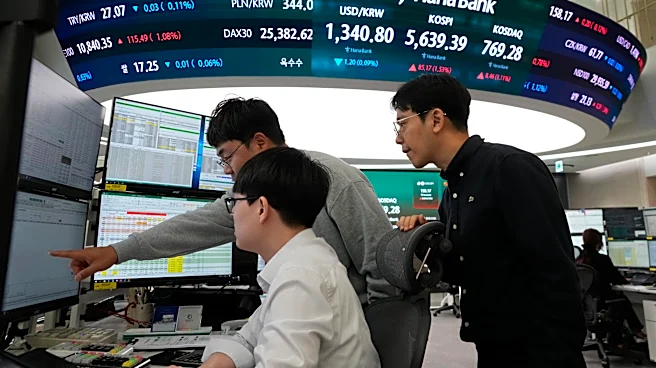
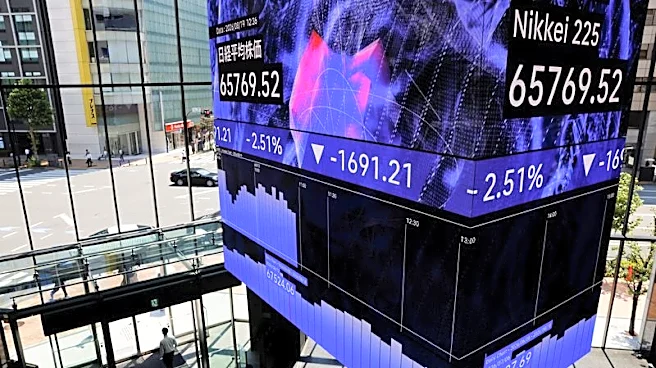
Asia-Pacific is projected to surpass the United States in financial-services value added by 2035, with a Deloitte report forecasting up to US$4.8 trillion for Asia-Pacific compared to US$4.3 trillion for the U.S. This economic shift is driven by rising
wealth, expanding middle classes, deeper capital markets, technological advancements, and increasingly sophisticated financial ecosystems across the region. While the U.S. maintains significant advantages in financial influence due to the dollar's dominance, deep capital markets, and robust financial infrastructure, Asia's economic transformation is testing this long-standing dominance. Matteo Giovannini, Senior Finance Manager at Industrial and Commercial Bank of China, suggests that a multipolar financial architecture is emerging, where American markets remain crucial, but Asian markets, including China, India, Japan, Singapore, and Hong Kong, gain increasing importance and influence.
Why It's Important?
This development is critically important for the U.S. as it signals a potential rebalancing of global financial power. While the U.S. dollar's role as the dominant international currency and the depth of American financial markets provide a strong foundation, the rapid growth of Asian financial centers could gradually erode this advantage. For U.S. industries and investors, this means navigating a more complex global financial landscape where capital formation, investment opportunities, and financial pricing may increasingly be influenced by Asian markets. The rise of a multipolar financial architecture could lead to increased competition for capital, a diversification of investment flows away from traditionally U.S.-centric channels, and potentially a reduced leverage for the U.S. in global financial governance. U.S. policymakers and businesses will need to adapt to this evolving environment to maintain competitiveness and influence.
What's Next?
The emergence of a multipolar financial architecture will likely lead to a gradual diversification of the global financial system. Asian companies are expected to raise more capital locally, and a growing share of regional savings will be managed by Asian institutions. Asian currencies may gain more relevance for trade and investment, and financial infrastructure designed around Asian markets could achieve greater international importance. For the U.S., the central question will be how to remain indispensable as the geography of global finance changes. This will involve adapting to new financial technologies, fostering strong international partnerships, and potentially re-evaluating existing financial regulations to ensure continued competitiveness. The relationship between China and the U.S. will be a key determinant of this new architecture, as financial competition increasingly intersects with broader strategic and geopolitical considerations.
Beyond the Headlines
Beyond the immediate economic implications, the rise of a multipolar financial world carries deeper significance for global power dynamics and international relations. It challenges the notion of a single global financial hegemon and could lead to a more distributed and potentially more resilient global financial system. However, it also introduces complexities related to regulatory harmonization, cross-border financial stability, and the potential for financial fragmentation along geopolitical lines. The increasing internationalization of currencies like the renminbi, even if from a low base, could gradually alter the dynamics of global trade and investment, potentially reducing reliance on the U.S. dollar for certain transactions. This shift could also empower emerging economies with greater financial autonomy, allowing them to pursue development paths less constrained by traditional financial institutions and policies.