







What's Happening?
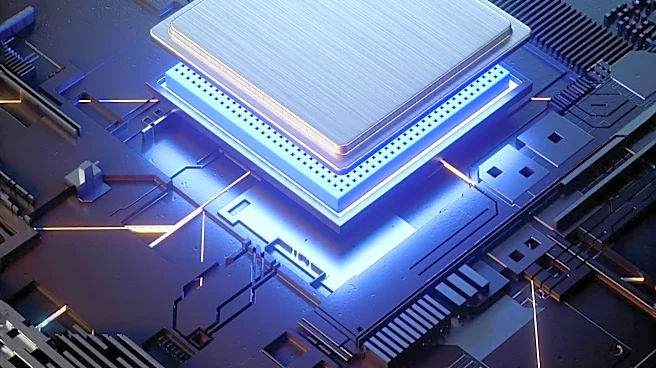
OpenAI, known for its AI models like ChatGPT and Codex, has partnered with Broadcom, a prominent silicon supplier, to introduce a new chip named Jalapeño. This chip is specifically designed for large language model (LLM) inference in data centers. The
collaboration marks the beginning of a long-term project aimed at refining these chips over time. The Jalapeño chip is an Application-Specific Integrated Circuit (ASIC) developed from scratch, informed by detailed insights from OpenAI's research and future model roadmaps. The development process took nine months, and the chip promises to be more specialized for the current needs of LLMs compared to existing systems. OpenAI has reported that early testing indicates the chip will deliver better performance per watt than current state-of-the-art solutions, although a detailed technical report is still forthcoming.
Why It's Important?
The introduction of the Jalapeño chip is significant as it represents a strategic move to enhance the efficiency and performance of AI model inference in data centers. This development could potentially lower operational costs and energy consumption for companies relying on large language models, thereby making AI technologies more accessible and sustainable. For OpenAI and Broadcom, this collaboration strengthens their positions in the competitive AI and semiconductor markets. The chip's improved performance metrics could attract more businesses to adopt AI solutions, driving further innovation and investment in the sector. Additionally, this advancement underscores the growing importance of specialized hardware in meeting the demands of increasingly complex AI applications.
What's Next?
As OpenAI and Broadcom continue to refine the Jalapeño chip, the next steps involve comprehensive performance testing and the release of a detailed technical report. This will provide further insights into the chip's capabilities and potential applications. The companies are likely to focus on scaling production and deployment across data centers globally. Stakeholders in the AI and tech industries will be watching closely to see how this new technology impacts the market and whether it sets a new standard for AI hardware. The success of this chip could lead to further collaborations and innovations in the field, potentially influencing the development of future AI models and applications.