





What's Happening?
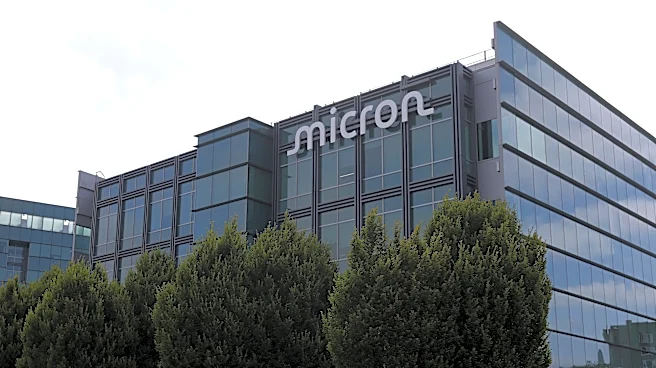
Micron Technology, a prominent global semiconductor company, has announced it will not implement price cuts for its memory products, citing an insatiable demand from the artificial intelligence (AI) market. The company specializes in designing and manufacturing
memory and storage solutions, including High Bandwidth Memory (HBM), DRAM, and data center SSDs, which are crucial components for AI systems, data centers, computers, and mobile devices. This decision comes as the company's stock has seen a significant 192% gain over the past 52 weeks, primarily fueled by the expansion of AI data centers and the robust demand for its memory chips. Micron's HBM chips are particularly noted for their ability to boost token efficiency when stacked directly above GPUs, indicating a strong technological advantage in the AI sector. The company's stance reflects a confident outlook on the sustained growth of the AI market and its integral role within it.
Why It's Important?
Micron's decision to forgo price cuts underscores the critical role of high-performance memory in the burgeoning AI industry and highlights the current supply-demand imbalance in the semiconductor market. This move signals to the broader technology sector that the cost of essential AI components is likely to remain high, potentially impacting the development and deployment costs for companies heavily invested in AI. For U.S. industries, particularly those in cloud computing, data centers, and AI development, this means continued high expenditure on memory solutions. Investors in Micron stand to benefit from sustained revenue and potentially higher profit margins, while companies reliant on these chips may face increased operational costs. The strong demand for HBM, DRAM, and data center SSDs indicates a foundational shift in computing needs, driven by the intensive data processing requirements of AI, making Micron a pivotal player in the technological landscape.
What's Next?
Micron anticipates a tighter market in 2027 and is actively investing over $250 billion in the U.S. to expand its DRAM capacity, alongside global expansions at existing fabrication facilities. However, the company acknowledges that building and bringing this new capacity online will take time. Micron has already secured significant future revenue, with 75% of its expected 2027 production already sold and 26 multi-year customer agreements totaling nearly $32 billion in upfront payments and other commitments. This provides substantial revenue visibility and strengthens the company's financial outlook. The ongoing investments and pre-sold capacity suggest a period of sustained growth and market leadership for Micron, as it works to meet the escalating demands of the AI sector.
Beyond the Headlines
The sustained demand for Micron's memory products, particularly HBM, points to a deeper trend in the evolution of computing infrastructure. The increasing complexity and scale of AI models necessitate specialized hardware that can handle massive datasets with unprecedented speed and efficiency. This creates a strategic imperative for nations, including the U.S., to invest in domestic semiconductor manufacturing and research to ensure a resilient supply chain for critical AI components. The ethical implications of AI's rapid advancement also come into play, as the foundational hardware like Micron's chips enables capabilities that could reshape various aspects of society, from automation to data analysis. The long-term shift towards AI-centric computing will likely drive further innovation in memory technology, pushing the boundaries of what's possible in digital systems and potentially leading to new industry standards and collaborations.