





What's Happening?
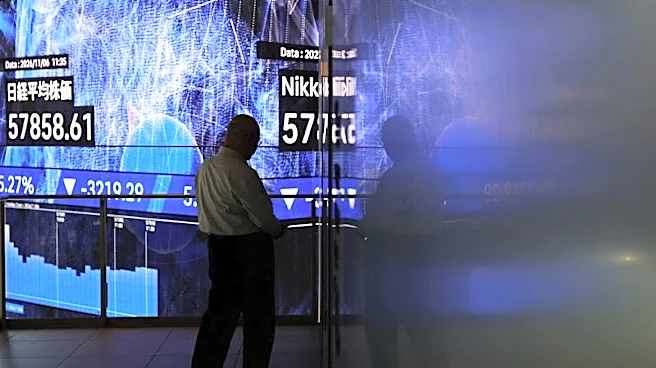
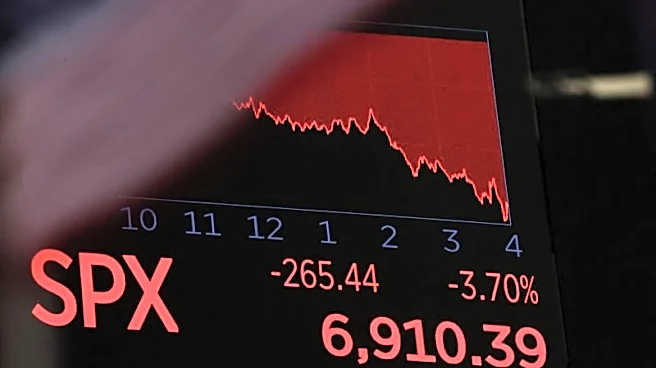
Fundstrat's Tom Lee and strategists at Citadel Securities hold differing views on whether the current U.S. stock market is reliving the 2018 sell-off. Tom Lee believes there will be less downside for U.S. stocks into year-end, rejecting fears of a repeat
of the 2018 market decline. His optimistic stance is primarily based on the significant upside potential offered by the artificial intelligence (AI) boom, a factor that was absent in 2018. Conversely, Citadel Securities strategists, including Frank Flight, head of macro strategy, and Nohshad Shah, head of EMEA fixed-income sales, warn that late-2018 risks are resurfacing. They point to high bond yields, a strengthening dollar, and a decline in economy-sensitive stocks as indicators of building pressure. Citadel also suggests that with inflation still above 3%, the Federal Reserve might not intervene to support stocks if they continue to fall, unlike previous instances.
Why It's Important?
This disagreement between prominent financial experts is crucial for U.S. investors and the broader economy, as it highlights conflicting interpretations of current market signals and future trajectories. If Tom Lee's assessment is correct, the market's current pullback could be a temporary dip, offering a buying opportunity, especially in AI-related stocks. This would imply that the transformative power of AI is strong enough to counteract traditional economic headwinds. However, if Citadel's warning proves accurate, the market could be facing a more significant and prolonged downturn, similar to 2018, with potential implications for investor portfolios and economic stability. The debate also underscores the Federal Reserve's critical role; its focus on inflation versus market stability will heavily influence whether a 'Fed put' (the expectation of Fed intervention to support markets) is still a viable assumption for investors. The outcome of this debate will determine whether AI earnings can indeed absorb tighter monetary conditions.
What's Next?
The coming weeks will be a critical test for both perspectives. Investors will closely monitor the Federal Reserve's actions, particularly any decisions regarding interest rate hikes in December, and their impact on market sentiment and corporate earnings. The performance of AI stocks will be a key indicator, as their ability to sustain growth and absorb tighter money will either validate Lee's thesis or lend credence to Citadel's concerns. Economic data, including inflation figures, bond yields, and the dollar's strength, will also be scrutinized for signs of either a strengthening economy or a deepening slowdown. The market's reaction to these factors will determine whether the current environment is merely a 'supply shock' that will pass, as Lee suggests, or the beginning of a more significant market correction, as warned by Citadel.
Beyond the Headlines
The contrasting views from Fundstrat and Citadel reflect a deeper philosophical divide in market analysis: whether technological innovation, specifically AI, can fundamentally alter traditional economic cycles and market responses to monetary policy. Lee's argument suggests a paradigm shift where AI acts as a powerful, independent growth engine. This perspective challenges the conventional wisdom that market downturns are inevitable when the Federal Reserve tightens monetary policy. Conversely, Citadel's stance emphasizes the enduring influence of macroeconomic fundamentals and the Fed's primary mandate to control inflation. This debate has broader implications for how investors should allocate capital, manage risk, and interpret economic indicators in an era of rapid technological change and evolving central bank policies. It also raises questions about the potential for new market bubbles driven by enthusiasm for emerging technologies versus the underlying economic realities.