







What's Happening?
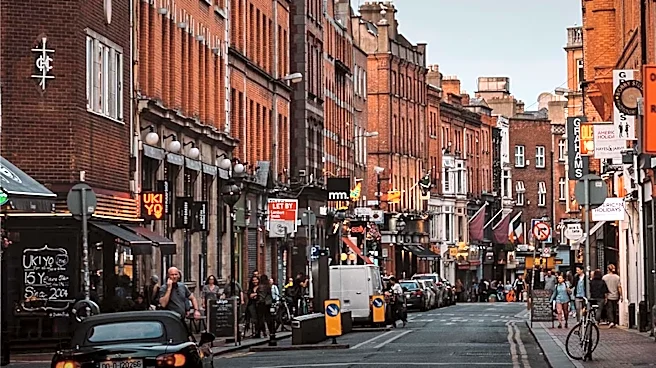
London is currently experiencing a notable resurgence in Irish language and culture, marked by increasing participation in language classes, cultural events, and community groups. Organizations like Croí na Gaeilge are hosting diverse events, including
Irish-speaking running clubs and queer meet-ups, moving beyond traditional settings. The Irish Cultural Centre in Hammersmith reports oversubscribed language classes and a meditation class conducted in Irish attracting 180 participants. The London Irish Centre in Camden is undergoing a multi-million-pound rebuild to include a cinema, public library, and London's first dedicated Irish theater. This cultural revival is also reflected in the music scene, with Irish acts gaining popularity and Irish passport applications increasing since Brexit. The demand for Irish language learning is so high that Duolingo reports it as the second most-studied language within Ireland itself, and London institutions face long waiting lists for courses.
Why It's Important?
This cultural revival signifies a deeper connection to Irish identity and heritage among London's population, including those with and without direct Irish ancestry. The increased visibility of Irishness, as indicated by a 2026 Core Research survey, suggests a growing appreciation for diverse cultural expressions within the UK. For individuals, learning the language offers a way to reconnect with their roots or explore a new cultural affinity, as highlighted by participants who find a sense of identity and community. Economically, the investment in cultural centers and the popularity of Irish artists contribute to the cultural economy of London. The surge in Irish passport applications post-Brexit also underscores a practical dimension to this cultural engagement, as individuals seek to maintain ties with the European Union, further intertwining cultural and political motivations.
What's Next?
The ongoing demand for Irish language classes and cultural events suggests a continued expansion of Irish cultural presence in London. The completion of the London Irish Centre's rebuild, which is explicitly mentioned in the Irish government's Diaspora Strategy for 2026 to 2030, is expected to further solidify London as a hub for Irish culture. This development will provide more dedicated spaces for language learning, arts, and community gatherings, potentially attracting even more participants. The trend of 'affinity diaspora,' where individuals without direct ancestral ties engage with Irish culture, is likely to grow, fostering a broader and more inclusive community. Educational institutions and cultural organizations will likely need to adapt to meet the escalating demand for Irish language and cultural programs.
Beyond the Headlines
The resurgence of Irish language and culture in London reflects broader societal shifts concerning identity, heritage, and community in a post-Brexit landscape. It highlights how cultural engagement can serve as a means of connection and belonging, particularly for those seeking a sense of identity beyond national borders. The concept of 'affinity diaspora' challenges traditional notions of cultural ties, demonstrating that shared interests and values can be as powerful as ancestral links in fostering cultural communities. This phenomenon also underscores the resilience of minority languages and cultures in urban environments, showcasing how they can thrive and attract new adherents through modern approaches, such as integrating with contemporary music and social activities. The support for humanitarian causes, like Ionad Hind Rajab in Gaza, through cultural events also points to a growing social consciousness within these communities.