




What's Happening?
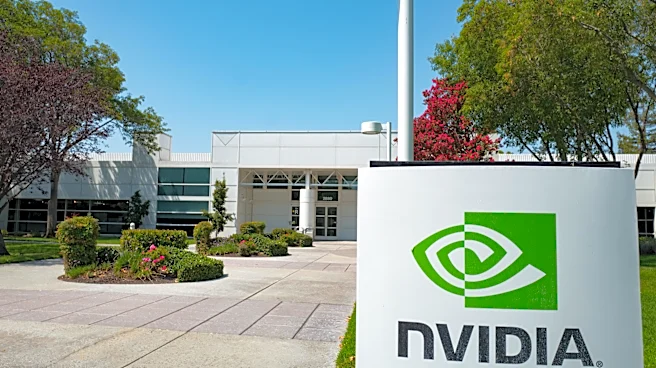
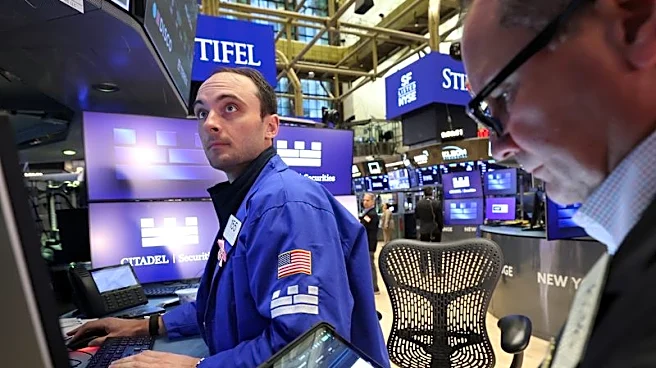
Nvidia's stock (NASDAQ:NVDA) is currently trading approximately 38% below its all-time high from October, despite the recent reinstatement of co-founder Jensen Huang as CEO on November 23. Following the announcement, the stock initially saw a surge but
has since relinquished some of those gains. This decline occurs even as the company reports an encouraging financial outlook. During the third quarter of fiscal 2027, which ended October 25, Nvidia generated $115.8 billion in revenue, marking a 103% year-over-year growth. Adjusted earnings per share (EPS) also increased by 111% to $2.68. Furthermore, management has raised its fiscal 2028 revenue guidance from 70% to 75%. The company anticipates finishing fiscal 2027 with approximately $424 billion in sales, projecting nearly $742 billion for the following year.
Why It's Important?
Nvidia's performance is a significant indicator for the broader technology and artificial intelligence (AI) sectors in the U.S. The company's robust revenue and earnings growth, coupled with an increased revenue guidance for fiscal 2028, suggest continued strong demand for its advanced computing platforms, particularly its Blackwell and upcoming Vera Rubin chip architectures. These technologies are crucial for data center expansion and AI infrastructure, impacting hyperscalers and various industries relying on AI. The stock's current valuation, described as historically inexpensive despite its recent sell-off, could present an opportunity for investors. The company's substantial share repurchase program, with $227.3 billion remaining, also signals confidence from management and could further boost shareholder value, influencing investment strategies across the market.
What's Next?
Nvidia is poised to continue benefiting from the robust demand for its Blackwell chip architecture, with the commercialization of its Vera Rubin architecture expected to be a major growth catalyst. The Vera Rubin platform, which integrates GPUs, Vera CPUs, and advanced networking technologies, is designed to broaden Nvidia's monetization opportunities across the AI infrastructure value chain. Management intends to execute its $227.3 billion share repurchase program by the end of fiscal 2028, which could provide ongoing support for the stock price. Analysts suggest that the 'Act 2' of AI, focusing on global rollout, is just beginning, implying sustained growth for companies like Nvidia that are foundational to AI development and deployment. Investors will be closely watching the company's performance in the coming quarters, particularly its ability to meet its ambitious revenue targets for fiscal 2028.
Beyond the Headlines
The ongoing narrative around Nvidia's stock, despite its strong fundamentals, highlights a broader market dynamic where investor sentiment can sometimes diverge from underlying financial performance. The 'AI trade' is seen by some analysts as being in its early stages, suggesting that the long-term implications of AI technology are still unfolding. Nvidia's comprehensive product portfolio, which allows it to monetize different layers of the AI infrastructure, positions it as a critical enabler of technological advancement. This extends beyond mere chip sales to influencing the pace and direction of AI innovation across various industries. The company's ability to sustain its growth will not only impact its own market capitalization but also the competitive landscape of the AI industry, potentially shaping which companies and sectors can effectively leverage AI for future development.