


What's Happening?
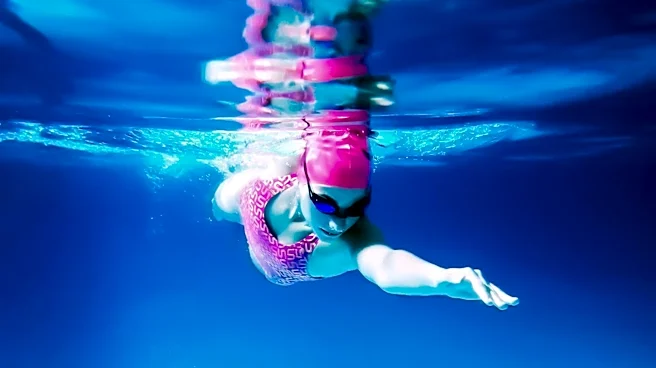
Mollie O'Callaghan, a 20-year-old Australian swimmer, has emerged as a global star after setting a new Olympic record in the 200-meter freestyle event. Her performance in Paris saw her overtake her training partner and reigning Olympic champion, Ariarne
Titmus, in the final 50 meters, securing the gold medal with a time of 1:53.27. This victory marks a significant moment in her career, transitioning her from a key member of Australia's successful relay teams to an individual Olympic champion. O'Callaghan's win was particularly notable as it involved a direct competition with Titmus, highlighting the depth of talent within Australian swimming. Her ability to maintain composure and accelerate in the final stretch of the race demonstrated a seasoned competitive mindset, despite her young age. This achievement follows her previous successes in the 2023 World Championships in Fukuoka, where she won both the 100 and 200-meter freestyle events, solidifying her position as a formidable individual competitor.
Why It's Important?
O'Callaghan's rise to individual Olympic gold is important for several reasons. It underscores the effectiveness of the Australian swimming system, which consistently produces world-class athletes and fosters intense, yet respectful, internal competition. Her victory, alongside Titmus's silver, showcases Australia's dominance in women's freestyle swimming, providing the country with multiple medal contenders in major international events. This internal rivalry, as seen between O'Callaghan and Titmus, pushes athletes to higher levels of performance, benefiting the sport as a whole. Furthermore, O'Callaghan's story of overcoming a strong rival and securing an Olympic record captivates audiences, drawing more attention to swimming and potentially inspiring a new generation of athletes. Her versatility in both sprint and middle-distance freestyle events makes her a valuable asset for Australia's relay teams, which are crucial for national pride and medal counts in international competitions. Her success also highlights the mental fortitude required in elite sports, demonstrating how strategic race execution and resilience can lead to victory even against established champions.
What's Next?
Following her Olympic record-breaking performance, Mollie O'Callaghan is expected to continue being a central figure in international swimming. Her immediate future will likely involve managing the demands of her newfound global recognition, including media engagements and maintaining her rigorous training schedule. As a key member of Australia's 4x100 and 4x200 freestyle relay teams, she will continue to contribute to her country's pursuit of team medals. The dynamic between her and Ariarne Titmus, both training partners and rivals, will be a compelling narrative in upcoming competitions, potentially pushing both athletes to even greater heights. O'Callaghan's ability to excel in both 100m and 200m freestyle events suggests she will remain a versatile and formidable opponent across various distances. Her career, still in its early stages, indicates a long and impactful presence in the sport, with future World Championships and Olympic Games likely to feature her prominently as she aims to build upon her current success.
Beyond the Headlines
O'Callaghan's triumph extends beyond mere athletic achievement, offering insights into the psychological and cultural aspects of elite sports. Her ability to perform under immense pressure, especially when trailing a formidable opponent like Titmus, speaks to a profound mental resilience and strategic understanding of her own capabilities. The narrative of a younger athlete surpassing an established champion, particularly one from the same training environment, highlights the cyclical nature of dominance in sports and the constant evolution of talent. This internal competition, while intense, also fosters a supportive environment where athletes push each other to improve. Culturally, O'Callaghan's success reinforces Australia's identity as a swimming powerhouse, where freestyle is almost a national language. Her story also illustrates the transition from a promising talent to a recognized star, a journey that involves not just physical prowess but also the ability to connect with an audience and manage the pressures of fame. Her emphasis on performing for Australia and her team, even after an individual victory, reflects a deep-seated team ethos that is often crucial for sustained success in high-performance sports.