




What's Happening?
Swiss startup coprod has successfully raised a $6 million pre-seed funding round. The investment was led by Founderful and PROTOTYPE, with additional participation from General Catalyst, Pace Ventures, Kima Ventures, and other angel investors, including
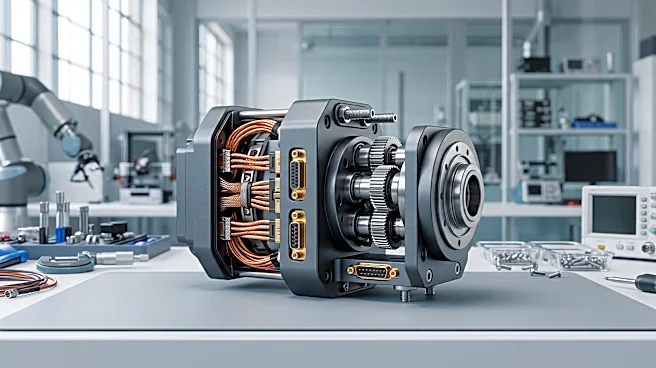
Thomas Wolf, co-founder of Hugging Face, and the Dassault family. Founded in late 2024 by graduates of the École polytechnique fédérale de Lausanne (EPFL), coprod aims to simplify the creation of robot hardware by offering modular components for sensing, motion, power, and batteries. These components are designed to connect via a unified EtherCAT architecture and a single real-time control API. The company's core mission is to address what it terms "integration hell" in the robotics industry, where integrators typically spend years and significant resources testing and debugging interfaces between disparate parts. coprod claims its system can reduce this process to a few months, a small team, and a cost of $5,000 to $25,000 per design iteration. The funding will be used to develop its first commercial components and establish a hardware prototyping facility in Lausanne, intended to accelerate development cycles.
Why It's Important?
This funding round for coprod is significant as it highlights a growing investment trend in the foundational layers of robotics technology, rather than solely in end-product robots. By focusing on modular hardware and a standardized integration platform, coprod could dramatically lower the barriers to entry and accelerate innovation within the robotics sector. The current "integration hell" described by the company represents a major bottleneck, hindering the rapid development and deployment of robotic solutions across various industries. If coprod's system proves effective at commercial scale, it could lead to faster, cheaper, and more efficient development of robots, impacting manufacturing, logistics, healthcare, and other sectors that rely on automation. This could particularly benefit U.S. companies seeking to integrate robotics into their operations, potentially boosting productivity and competitiveness. McKinsey estimates that the specialized actuators, sensors, and control systems coprod is developing could form a $28 billion market by 2030, indicating a substantial economic opportunity for companies providing these enabling technologies.
What's Next?
coprod plans to use the newly acquired funds to develop its initial commercial components and establish a hardware prototyping facility in Lausanne. This facility is designed to significantly shorten development cycles, aiming to reduce them from two weeks to just 24 hours. While coprod's components are already being utilized in the Swiss ecosystem, including by the ETH Robotics Club, the full product line is not expected to be qualified and available until the end of 2027. The company's future success hinges on the widespread adoption of its system by developers and its ability to deliver on the promise of faster and cheaper integration at a commercial scale. Potential reactions from major stakeholders in the robotics industry will likely depend on the demonstrated efficacy and cost-effectiveness of coprod's solutions once they become more broadly available. If successful, coprod could become a key enabler for a new generation of robotic applications.
Beyond the Headlines
The investment in coprod points to a broader strategic shift within the robotics industry, emphasizing the importance of interoperability and standardization in hardware development. Historically, the bespoke nature of robotics integration has created significant technical and financial hurdles, limiting the scalability and accessibility of robotic solutions. coprod's approach, akin to making hardware development as straightforward as software coding, could foster a more agile and collaborative ecosystem. This could lead to a democratization of robotics, allowing smaller companies and startups to innovate more rapidly without the prohibitive costs and complexities of traditional integration. Furthermore, by addressing component supply chain issues, which have throttled production for major robot makers like Figure AI and Tesla, coprod's model could contribute to greater resilience and efficiency in the global robotics supply chain. The long-term implications include a potential acceleration of automation across various sectors, impacting labor markets, industrial productivity, and the overall technological landscape.