





What's Happening?
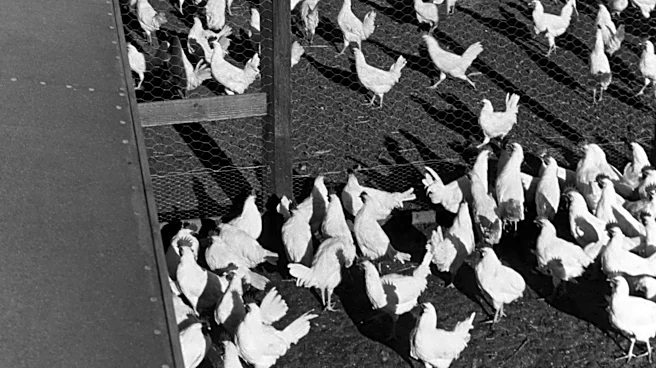
Perdue Farms, headquartered in Salisbury, Maryland, has been recognized as a major integrated poultry and feed producer in the United States. The company is vertically integrated, meaning it manages various stages of its production process, including
feed milling operations. This integration is a key characteristic of its business model within the broader animal feed industry. The company operates within a competitive landscape that includes other significant players in the feed and protein production sectors, both domestically and globally. The focus on integrated operations allows Perdue Farms to maintain control over its supply chain, from feed production to poultry processing, which is a common strategy among large-scale agricultural businesses aiming for efficiency and quality control. The broader market for pressure-flaked feeds, which Perdue Farms likely utilizes in its operations, is experiencing structural expansion driven by the livestock industry's demand for higher feed efficiency and precision nutrition. This market is projected to grow, with a compound annual growth rate of 4.2% in value terms from 2026 to 2035.
Why It's Important?
Perdue Farms' position as a major integrated poultry and feed producer is significant for several reasons. Its vertical integration contributes to the stability and efficiency of the U.S. poultry supply chain, influencing the availability and cost of poultry products for consumers. The company's involvement in feed milling operations means it plays a role in the demand for and processing of agricultural commodities like grains, impacting farmers and the broader agricultural economy. As the pressure-flaked feeds market expands, driven by the need for enhanced animal nutrition and feed conversion ratios, companies like Perdue Farms are crucial in adopting and implementing these advancements. This focus on efficiency directly affects the profitability of livestock operations and the sustainability of food production. The company's scale and integrated approach also mean it is a significant employer and economic contributor in its operating regions, particularly in Maryland and other areas where its facilities are located.
What's Next?
As the global pressure-flaked feeds market is projected to grow, Perdue Farms will likely continue to invest in and optimize its feed milling operations to enhance efficiency and meet evolving nutritional demands for its poultry. The company may explore further technological advancements in feed processing to improve starch gelatinization and nutrient availability, aligning with broader industry trends. Given the increasing focus on feed cost optimization and feed conversion ratios in commercial livestock operations, Perdue Farms will likely continue to prioritize strategies that enhance these metrics. The company may also adapt to changing consumer demands, such as the rising interest in organic and protein-enhanced flaked products, by adjusting its feed formulations and production practices. Furthermore, as the livestock industry consolidates into larger, more technically sophisticated operations, Perdue Farms' integrated model positions it to adapt to these shifts and potentially expand its market presence or refine its operational strategies.
Beyond the Headlines
The integrated model employed by Perdue Farms highlights a broader trend in the agricultural industry towards consolidation and vertical integration. This approach offers benefits such as greater control over product quality, supply chain stability, and cost efficiencies, but it also raises questions about market concentration and its impact on smaller farmers and independent producers. The reliance on advanced feed processing technologies, like pressure flaking, underscores the scientific and technological sophistication now embedded in modern food production. This continuous drive for efficiency in animal nutrition has ethical implications regarding animal welfare and the environmental footprint of large-scale livestock operations. As consumer awareness of these issues grows, companies like Perdue Farms face increasing scrutiny and pressure to adopt more sustainable and ethical practices throughout their integrated supply chains, from feed sourcing to animal husbandry and processing. The long-term success of such integrated producers will increasingly depend not only on economic efficiency but also on their ability to address these broader societal and environmental concerns.