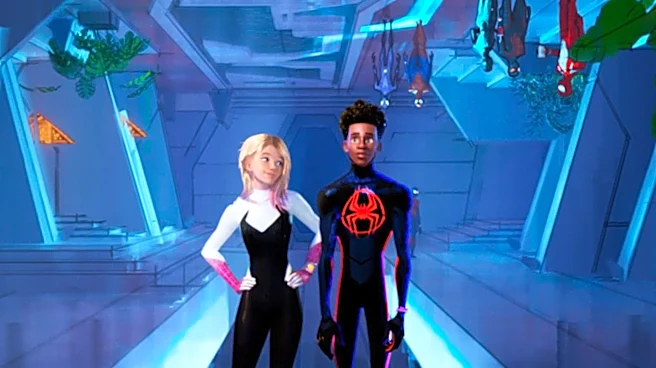








What's Happening?
Mainstream computer-animated films in Hollywood are undergoing a significant shift in aesthetic and narrative styles, moving away from the uniform visual identity that dominated for decades following Pixar’s 1995 debut film, 'Toy Story'. This change is largely
attributed to the critical and commercial success of Sony’s 2018 film, 'Spider-Man: Into the Spider-Verse'. The film was lauded for its distinct visual style and its innovative use of animation to enhance storytelling. This 'post-Spiderverse boom' has led to a trend among several mainstream Hollywood studios to adopt more developmental styles, departing from earlier orthodox formulas. This includes exploring more abstract, internal, and complex concepts such as race, identity, youth, mortality, and mental health, rather than solely focusing on 'hyperreal' storytelling. Pixar's 'Soul' (2020) is cited as an example of this stylistic expansion, selectively abstracting spatial and character designs to loosen the studio’s unified computer-generated imagery, while still maintaining elements of 'stylized realism' in its depiction of New York.
Why It's Important?
This evolution in computer-animated filmmaking signifies a broader artistic and commercial re-evaluation within the U.S. entertainment industry. The departure from a singular, 'hyperreal' visual style opens up new avenues for creative expression and storytelling, potentially leading to a more diverse range of animated content. For audiences, this means a richer and more varied cinematic experience, with films that tackle complex themes and employ innovative visual techniques. For animation studios, it represents a challenge to traditional production methodologies and an opportunity to push the boundaries of the medium. The success of 'Spider-Man: Into the Spider-Verse' demonstrated that audiences are receptive to experimental animation, which could encourage further investment in diverse artistic approaches. This shift could also influence talent development within the industry, fostering a demand for animators and storytellers skilled in non-traditional techniques and conceptual thinking. Ultimately, it reflects a maturation of the computer animation medium, allowing it to address more profound and nuanced aspects of the human experience.
What's Next?
The trend of adopting developmental styles in Hollywood computer-animated films is expected to continue, with upcoming releases likely to further explore experimental forms and complex narratives. The success of films like 'Spider-Man: Into the Spider-Verse' and 'Soul' suggests a growing appetite among audiences for animation that challenges conventional aesthetics and storytelling. This could lead to increased investment in research and development for new animation techniques and software, as studios strive to differentiate their offerings. We may also see a greater emphasis on collaboration between artists from diverse backgrounds, bringing fresh perspectives to animated projects. The industry will likely continue to grapple with how to balance artistic innovation with commercial viability, as studios seek to replicate the critical and financial success of these groundbreaking films. This ongoing evolution could solidify animation's position as a powerful medium for exploring a wide array of human experiences and artistic expressions.
Beyond the Headlines
The shift in computer-animated film styles extends beyond mere aesthetics, reflecting deeper cultural and societal changes. The willingness of major studios to embrace abstract and complex themes like identity, mortality, and mental health indicates a growing recognition of animation's capacity to engage with profound human experiences. This move away from purely escapist or child-centric narratives suggests a broader acceptance of animation as a sophisticated art form capable of addressing adult audiences and tackling serious subjects. Ethically, this development could lead to more inclusive and representative storytelling, as diverse perspectives are brought to the forefront. Culturally, it challenges the long-held perception of animation as a niche genre, elevating its status within the broader cinematic landscape. This evolution could also influence other creative industries, inspiring similar experimentation in visual arts, gaming, and digital media, as the boundaries of what is considered 'mainstream' continue to expand.