







What's Happening?
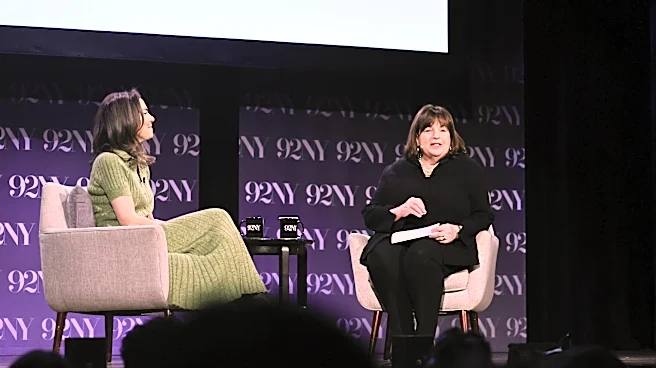
Author Emily St. John Mandel, known for works like 'Station Eleven' and her new book 'Exit Party,' explores complex scientific ideas in her fiction, despite not having a formal science background. Mandel discusses how she uses concepts like time travel,
the simulation hypothesis, and the multiverse as frameworks to delve into human experiences and societal structures. For her novel 'Sea of Tranquility,' she tackled the paradoxes of time travel by incorporating the simulation hypothesis. In 'Exit Party,' she uses the idea of doppelgängers to represent 'counter lives'—alternative paths individuals and even states might have taken. Mandel emphasizes that her focus is on how characters respond to these speculative scenarios, rather than strict scientific accuracy, aiming for plausibility within a literary context. She also touches on the theme of transience, finding hope in the idea that difficult situations, like dystopian states, do not last forever.
Why It's Important?
Mandel's approach highlights the significant role of science fiction in contemporary literature, moving beyond mere technological speculation to explore profound philosophical and societal questions. By using scientific concepts as narrative devices, she encourages readers to consider alternative realities and the impact of pivotal choices on individual lives and national trajectories. This method allows for a deeper examination of human nature, resilience, and the transient nature of existence, resonating with audiences grappling with complex modern challenges. Her work demonstrates how speculative fiction can serve as a powerful tool for social commentary and introspection, offering unique perspectives on issues ranging from personal identity to political systems, thereby enriching the broader literary landscape and intellectual discourse.
Beyond the Headlines
Mandel's discussion of 'counter lives' and the 'counter life of the state' offers a compelling lens through which to view historical events and political decisions. By imagining how different choices could have led to vastly altered realities, her work implicitly encourages critical thinking about current societal structures and potential futures. This perspective can foster a deeper understanding of the contingency of present circumstances and the agency individuals and collectives have in shaping their destinies. Furthermore, her emphasis on transience—that both good and bad situations eventually pass—provides a philosophical framework for coping with uncertainty and change, offering a subtle message of hope and adaptability in an often unpredictable world. This thematic depth elevates her science fiction beyond entertainment, positioning it as a vehicle for profound ethical and existential inquiry.