





What's Happening?
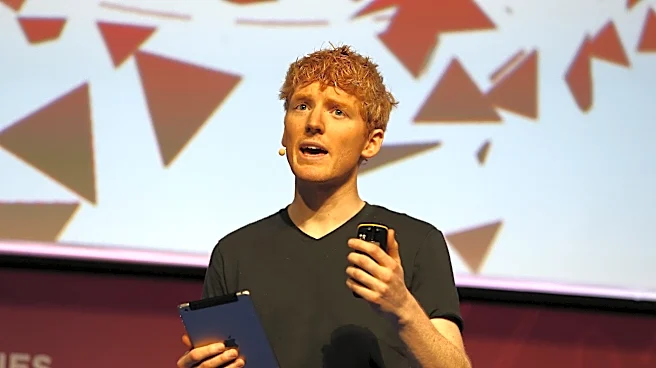
Stripe co-founder and president John Collison is spearheading the company's strategic shift to become foundational infrastructure for what he terms the 'agentic economy.' This year, Stripe launched 288 new products at its Sessions 2026 event, focusing
on billing and routing capabilities essential for the artificial intelligence (AI) era. Key acquisitions, including OpenRouter, Parafin, and Metronome, have bolstered these efforts. Collison has also been vocal about agentic commerce and AI security, discussing these topics on his show 'Cheeky Pint' and in various interviews. His influence extends beyond Stripe, as Microsoft has nominated him to join its board of directors, with a shareholder vote scheduled for December 8. This nomination follows the departures of Reid Hoffman and Hugh Johnston from Microsoft's board. Collison, along with Patrick Collison, also co-signed an investor letter in August, suggesting the world entered a 'singularity' on January 1, a sentiment he reiterated in an October interview.
Why It's Important?
Stripe's aggressive pivot towards the 'agentic economy' under John Collison's leadership signals a significant transformation in how businesses are expected to operate in the AI era. By developing infrastructure for agent wallets and Treasury for agents, Stripe is positioning itself at the core of future automated commerce. This move is crucial for U.S. businesses, as Collison emphasizes that the entire security landscape is shifting due to AI, necessitating immediate attention from enterprises. His view that AI will restructure the economy faster than electrification suggests a profound impact on various sectors, compelling companies to adapt rapidly. The focus on usage-based billing for AI products reflects a changing corporate spending structure, where AI and inference costs are expanding. Collison's assertion that 'software is no longer the point' and that proprietary data, network effects, and physical operations will be more valuable highlights a fundamental shift in competitive advantage, potentially reshaping market leaders and strategies across industries.
What's Next?
The immediate next step for John Collison involves the Microsoft board nomination, with a shareholder vote scheduled for December 8. His potential appointment to Microsoft's board could further solidify his influence in the broader technology landscape and potentially foster deeper collaborations or strategic alignments between Stripe and Microsoft in the AI domain. For Stripe, the ongoing development and integration of its 288 newly launched products will be critical in establishing its infrastructure for the 'agentic economy.' The company will likely continue to expand its partnerships, such as those with Anthropic, Meta Muse, and Google, to enhance its AI capabilities and reach. Collison's continued public discourse on AI's impact, particularly regarding AI security and the restructuring of the economy, will likely shape industry conversations and guide businesses in their AI adoption strategies. The concept of an 'agentic economy circle' combining stablecoins for micropayments suggests future innovations in financial transactions for small data exchanges.
Beyond the Headlines
John Collison's vision of an 'agentic economy' and his assertion that the world has been in a 'singularity' since January 1, 2026, point to a deeper philosophical and economic shift. This perspective suggests a future where autonomous AI agents play a central role in commerce, potentially redefining traditional business models and human-computer interaction. The emphasis on stablecoins for micropayments within this agentic economy highlights the potential for a new financial infrastructure that supports granular, automated transactions, which could have profound implications for digital currencies and financial regulation. Furthermore, Collison's view that 'software is no longer the point' challenges the long-held belief in software as the primary driver of value in the tech industry. Instead, he posits that proprietary data, network effects, and physical operations will become more critical, suggesting a re-evaluation of what constitutes competitive advantage in an AI-saturated world. This shift could lead to a re-prioritization of investments and strategic focus for technology companies and startups alike.