
What's Happening?
Allus, a Y Combinator startup, has successfully raised $6 million in a previously undisclosed seed funding round in the spring of 2026. The funding round saw participation from Y Combinator, Transpose,
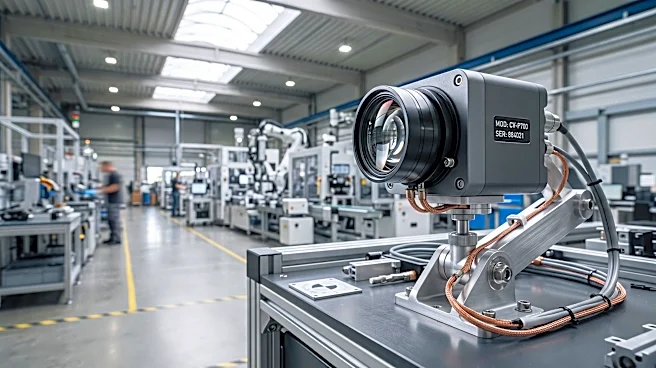
Pioneer, and several angel investors. Allus, co-founded by Kai Cui, Shijie Wang, and Zhisen An, originated from research at the Georgia Institute of Technology. The company is dedicated to bridging the gap in physical AI adoption within manufacturing by developing solutions that monitor operations and workflows using computer vision. Their goal is to identify and rectify inefficiencies while standardizing data to train future physical AI systems. Allus operates with a bicoastal strategy, maintaining bases in Silicon Valley and Atlanta to leverage both AI talent and manufacturing expertise.
Why It's Important?
The investment in Allus highlights a critical challenge and opportunity within the U.S. manufacturing sector: the scarcity of standardized data for physical AI. By focusing on computer vision to monitor and standardize manufacturing data, Allus aims to unlock the full potential of physical AI, which can significantly enhance operational efficiency, quality control, and predictive maintenance. This development is crucial for U.S. industries seeking to maintain global competitiveness through advanced automation and smart factory initiatives. The ability to collect and standardize data from factory floors will empower manufacturers to make data-driven decisions, reduce waste, and improve product quality. Companies that adopt such technologies stand to gain substantial advantages in productivity and cost-effectiveness, while those that lag may face increased operational challenges.
What's Next?
Allus plans to utilize the $6 million seed funding to expand its team across various departments and continue the development of its AI technology. The company is actively working with a prominent physical AI company on a physical intelligence platform, aiming to scale its customer base in 2027. This expansion will likely involve refining its existing products, AllusOne for quality control and AllusFlow for data analysis and standardization, and potentially developing new solutions. The success of Allus could pave the way for more startups to focus on data infrastructure for physical AI, further accelerating the adoption of AI in manufacturing. The company's bicoastal strategy also suggests a model for leveraging diverse talent pools to address complex technological challenges.
Beyond the Headlines
The work of Allus in standardizing data for physical AI in manufacturing has broader implications for industrial automation and the future of work. As AI becomes more integrated into physical processes, the need for robust and reliable data infrastructure becomes paramount. This raises ethical considerations regarding data ownership, privacy, and the potential impact on human labor. The development of sophisticated AI systems that can learn from real-world manufacturing data could lead to highly autonomous factories, transforming supply chains and production methods. However, it also necessitates a focus on cybersecurity to protect sensitive operational data and prevent disruptions. The long-term shift could see a redefinition of manufacturing roles, emphasizing human-AI collaboration and advanced technical skills.