






What's Happening?
Taiwan Semiconductor Manufacturing Company (TSMC) is reportedly preparing to implement a series of price increases for its advanced packaging and fabrication services. This move comes as the artificial intelligence (AI) boom places significant demand
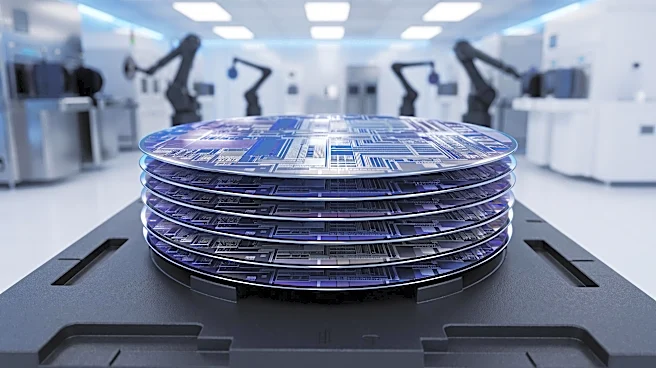
on the semiconductor supply chain, leading to physical constraints in manufacturing. TSMC's proprietary Chip-on-Wafer-on-Substrate technology is the industry standard for integrating high-bandwidth memory with compute dies, a critical component for modern AI accelerators. The company is expected to raise prices for its advanced packaging services by 10% to 20%. Additionally, wafer prices for TSMC's advanced 2-nanometer and 3-nanometer nodes could see an increase of 3% to 6% starting in early 2027. These price adjustments are intended to help TSMC offset its substantial expansion costs, including a projected capital expenditure of $60 billion-$64 billion in 2026. The company aims to ramp up its monthly advanced packaging capacity to approximately 130,000 wafers by the end of 2026, with a further increase to 200,000 wafers by 2027.
Why It's Important?
TSMC's decision to increase pricing highlights its dominant position in the high-end AI chip manufacturing and packaging market. Fabless chip designers, such as NVIDIA and Advanced Micro Devices, have limited negotiation power due to their heavy reliance on TSMC's specialized technology and manufacturing capabilities. The extended testing cycles required for new architectures like NVIDIA's Blackwell and Rubin further lock designers into prioritizing guaranteed production slots over unit costs. This pricing power allows TSMC to maintain high net margins, currently around 51.5%, even while undertaking one of the largest industrial expansions in recent history. The ability to pass on capital expenditure requirements directly to customers ensures the company's continued investment in advanced technology. This situation underscores the critical role of foundries in the AI ecosystem and the potential for inflationary pressures within the silicon supply chain to impact downstream industries and consumers.
What's Next?
The anticipated price increases from TSMC are expected to take effect, with advanced packaging services seeing hikes of 10% to 20% and wafer prices for advanced nodes increasing by 3% to 6% starting in early 2027. Downstream clients will likely absorb these higher fabrication and packaging costs, which could lead to increased prices for end-market consumer hardware. Investors will be closely monitoring hardware sales data to assess whether consumers can absorb these rising AI infrastructure costs without dampening overall demand. TSMC's strategy of prioritizing scale over immediate cost efficiency, by placing equipment orders without negotiating vendor discounts, indicates a continued focus on expanding its advanced packaging capacity. The company's disciplined approach to partnerships, as seen in its refusal to yield operational control in the proposed Terafab project, suggests it will continue to prioritize fully controlled, high-margin operations.
Beyond the Headlines
The pricing adjustments by TSMC reveal a deeper dynamic within the technology sector, where the physical layer of the AI ecosystem operates under different economic rules than software development. While software companies compete on subscription pricing, the scarcity and specialized nature of advanced chip manufacturing grant significant leverage to companies like TSMC. This situation could lead to a 'trickle-down' inflation effect, where the increased costs of foundational AI components eventually impact the broader economy through higher prices for AI-powered devices and services. The concentration of advanced manufacturing capabilities in a few key players, particularly TSMC, also raises questions about supply chain resilience and potential geopolitical implications. The company's strategic restraint in partnerships, prioritizing proprietary control and operational efficiency, reinforces its competitive moat but also limits the diffusion of its advanced manufacturing expertise.