



What's Happening?
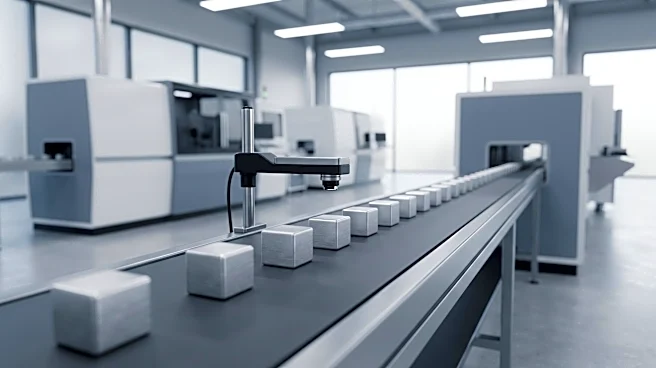
HighByte has implemented a new serial deduplication feature designed to address inaccuracies in manufacturing outfeed counts. This issue arises when items, particularly those undergoing rework or double-cycling, are counted multiple times as they pass
through the same machine. The problem leads to a discrepancy between the physical number of items and the recorded count, where, for example, 15 physical items might be recorded as 17 due to some being processed twice. The core of the problem is that serial numbers are not being deduplicated before data aggregation, causing inflated outfeed counts while waste counts remain unchanged. HighByte's solution aims to correct this by integrating deduplication logic within its pipelines, ensuring that downstream systems like Ignition SCADA and Manufacturing Execution Systems (MES) receive pre-corrected data.
Why It's Important?
This development is crucial for U.S. manufacturing industries as it directly impacts data accuracy and operational efficiency. Inaccurate production counts can lead to significant financial losses, incorrect inventory management, and flawed production planning. By ensuring precise outfeed counts, businesses can improve their supply chain visibility, reduce waste, and make more informed decisions regarding production schedules and resource allocation. The ability to accurately track items, even those that re-enter the production line, enhances overall quality control and compliance. This feature benefits manufacturers by providing a reliable data foundation, which is essential for optimizing complex industrial processes and maintaining competitiveness in a data-driven economy. Companies that adopt this technology stand to gain from improved operational transparency and reduced discrepancies in their production metrics.
What's Next?
Manufacturers utilizing HighByte's platform will need to integrate and configure the new serial deduplication logic into their existing data pipelines. HighByte offers two primary approaches: an event-driven/cycle-by-cycle pattern for real-time accuracy in processes with cycle times exceeding 500ms, and a periodic/batch pattern for faster cycle times where real-time Human-Machine Interface (HMI) accuracy is less critical than throughput. Companies will also need to consider database schema design for tracking processed serials and implement deployment recommendations, such as installing database servers on separate machines and establishing retention policies. Monitoring for chronic re-processing issues through alerts for 'Seen_Count > 2' will be a key next step to ensure the system's effectiveness and identify potential operational bottlenecks.
Beyond the Headlines
The introduction of serial deduplication by HighByte highlights a broader industry trend towards enhancing data integrity and automation in manufacturing. Beyond simply correcting counts, this technology fosters a more robust digital twin environment, where the virtual representation of a physical process is more accurate and reliable. This precision is vital for the advancement of Industry 4.0 initiatives, enabling more sophisticated analytics, predictive maintenance, and ultimately, lights-out manufacturing. The ethical implications revolve around trust in automated systems; accurate data builds confidence in AI-driven decision-making and reduces the need for human intervention in data validation. Long-term, this could lead to a significant shift in how manufacturing data is perceived and utilized, moving from reactive problem-solving to proactive optimization and greater operational autonomy.