





What's Happening?
Firefly Aerospace has announced a commercial payload agreement with Starcloud to demonstrate advanced AI computing capabilities in lunar orbit. Starcloud's SC-1L computing payload will be integrated onto Firefly's Elytra orbital vehicle as a commercial rideshare
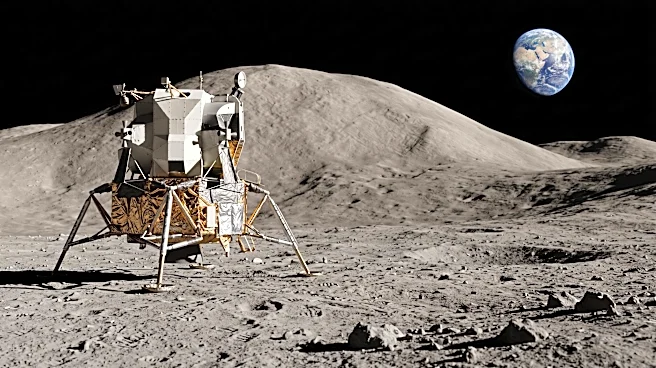
on the Blue Ghost Mission 3, which is targeted for launch no earlier than 2028. This mission will initially serve as a transfer stage and communications relay for Firefly's Blue Ghost lander, which will land on the Moon's Gruithuisen Domes as part of NASA's Commercial Lunar Payload Services (CLPS) initiative. After the lander mission concludes, the Elytra vehicle will remain in lunar orbit for up to five years, hosting Starcloud's SC-1L payload and Firefly's Ocula imaging service. The SC-1L processor will ingest raw imagery from Firefly's Solux vision system, perform high-power AI inference on orbit, and then transmit only the processed results back to Earth, addressing the bandwidth limitations of transmitting raw data over long distances.
Why It's Important?
This collaboration marks a significant step towards establishing commercial infrastructure for a permanent human and robotic presence on the Moon. By processing data directly in lunar orbit, the SC-1L payload aims to overcome the substantial bandwidth bottleneck associated with transmitting raw sensor data from the Moon to Earth. The round-trip light-travel time of approximately 2.56 seconds between the Moon and Earth makes real-time interactive AI from Earth-based data centers impractical for lunar operations. This 'edge computing' approach in space, where data is processed at the source, is crucial for efficient lunar exploration and resource utilization. It also signifies the growing maturity of the lunar economy, attracting commercial customers like Starcloud who see a near-term operational need for compute capabilities beyond Earth orbit, independent of direct NASA affiliation. This development could pave the way for more robust and autonomous lunar missions, reducing reliance on Earth-based processing and enabling faster decision-making for lunar activities.
What's Next?
The Blue Ghost Mission 3, carrying the Starcloud SC-1L payload, is scheduled for launch no earlier than 2028. Prior to this, Firefly is targeting the launch of Blue Ghost Mission 2 no earlier than 2027, which will deploy another Elytra vehicle to lunar orbit. Following the completion of the Blue Ghost lander mission on Gruithuisen Domes, the Elytra orbiter will transition into a commercial services platform, operating for up to five years in lunar orbit. During this extended operational phase, it will host Firefly's Ocula imaging service, an NVIDIA Jetson module for lunar surface mapping, and Starcloud's SC-1L AI compute payload. Starcloud also plans to launch its second satellite, targeting 2027, which will carry multiple NVIDIA H100 chips and integrate NVIDIA's Blackwell architecture for enhanced AI performance, further expanding its orbital compute capabilities.
Beyond the Headlines
This initiative highlights a fundamental shift in how space exploration and lunar development are being approached, moving towards a more distributed and autonomous computing model. The concept of 'cislunar compute' is emerging as a distinct category, different from traditional cloud computing in low Earth orbit, due to the unique challenges of latency and bandwidth at lunar distances. The ability to perform AI inference directly in lunar orbit could have profound implications for scientific research, resource extraction, and the establishment of lunar bases, enabling more sophisticated data analysis and decision-making on-site. Furthermore, the involvement of companies like Starcloud, which has rapidly achieved unicorn status and secured investments from entities like the In-Q-Tel venture fund (backed by the CIA), underscores the strategic importance of orbital compute for national security applications and the broader commercialization of space. This trend suggests a future where lunar operations are increasingly self-sufficient in terms of data processing and intelligence.