








What's Happening?
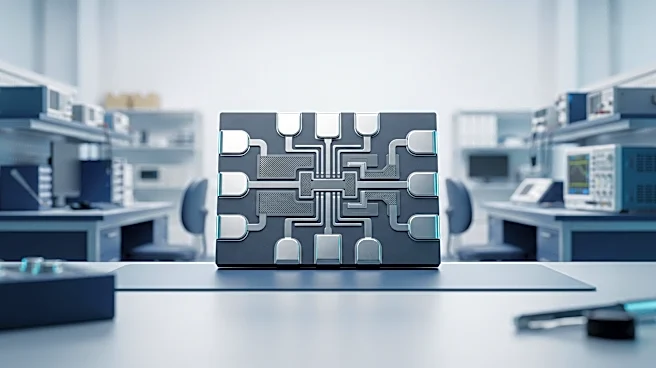
Enphase Energy, a global energy technology company, in collaboration with Infineon, has announced the development of the world's first 900 V GaN bidirectional switch (BDS) devices. These devices are designed for AI data center solid-state transformers
(SSTs) and are currently being integrated into Enphase's IQ® Solid-State Transformer (IQ SST) development builds, with production qualification anticipated to follow. The new 900 V GaN devices allow for higher voltage operation while maintaining high-frequency switching, which is crucial for power density, efficiency, and uptime in AI data centers. This technology enables a single-stage architecture with reduced electromagnetic interference (EMI) and fewer points of failure. The higher voltage capability means fewer inverters are needed in series for medium-voltage inputs, leading to lower system-level losses and a reduced component count in the power path. Enphase has been researching GaN power conversion for over 10 years and has already deployed 650 V GaN BDS devices in its IQ9™ Microinverters. This collaboration with Infineon extends their GaN technology beyond 650 V, utilizing Infineon's CoolGaN™ bidirectional switch portfolio to facilitate medium-voltage systems.
Why It's Important?
This technological breakthrough by Enphase Energy and Infineon is highly significant for the U.S. energy and technology sectors, particularly given the rapidly escalating power demands of AI data centers. The introduction of 900 V GaN BDS devices promises to enhance the efficiency, reliability, and scalability of power conversion solutions. For AI data centers, where power consumption is a critical economic factor, these devices can lead to substantial reductions in operational costs through lower energy losses and improved power density. This innovation also benefits commercial solar inverters, enabling more efficient three-phase designs for 480 V applications in the United States. By allowing for fewer components and higher operating voltages, the technology can reduce the overall cost and complexity of power systems. The ability to shrink transformers and other magnetics due to high-frequency switching also contributes to smaller, lighter, and more cost-effective power solutions. This advancement positions U.S. companies like Enphase at the forefront of developing sustainable and efficient power infrastructure for the burgeoning AI industry, potentially influencing global standards for power electronics.
What's Next?
The 900 V GaN BDS devices are currently undergoing integration into Enphase's IQ SST development builds, with production qualification expected in the near future. Following successful qualification, these devices will be commercialized and deployed in AI data center infrastructure and commercial solar products. Enphase Energy will likely continue to leverage its collaboration with Infineon to further advance GaN technology, potentially exploring even higher voltage applications and broader integration across its product portfolio. The company's focus on addressing the power demands of AI data centers suggests a strategic move to capture a significant share of this growing market. Additionally, the benefits of this technology for commercial solar inverters indicate a potential expansion of its application in renewable energy systems. The successful deployment and performance of these devices will be closely watched by the industry, as they could set new benchmarks for power conversion efficiency and reliability, influencing future design and development in both AI infrastructure and solar energy sectors.
Beyond the Headlines
The development of 900 V GaN bidirectional switch devices represents a critical step in addressing the broader energy challenges posed by the rapid expansion of AI and data centers. As AI workloads become more intensive, the demand for power is surging, making energy efficiency paramount. This technology not only improves the performance of individual components but also enables more compact and robust power architectures, which can reduce the physical footprint and environmental impact of data centers. The shift towards GaN-based power electronics signifies a move away from traditional silicon-based solutions, offering superior performance characteristics such as lower switching losses and higher operating temperatures. This could accelerate the adoption of advanced materials in power conversion, driving further innovation in semiconductor technology. Furthermore, the application of these devices in both AI data centers and commercial solar inverters highlights the interconnectedness of energy infrastructure and technological advancement, suggesting a future where efficient power management is central to both digital innovation and sustainable energy solutions. This could lead to new regulatory considerations and industry standards for energy consumption in high-tech sectors.