





What's Happening?
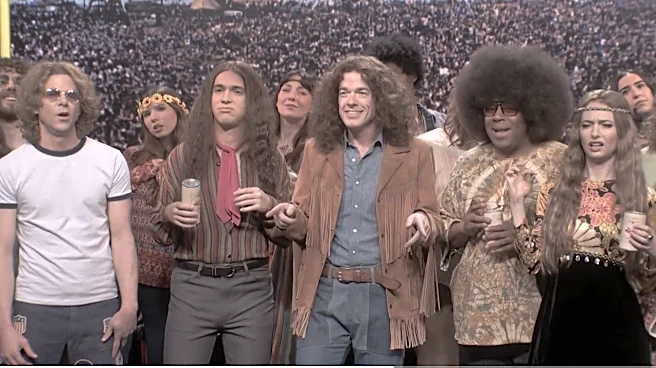
During a recent 'Saturday Night Live' episode hosted by John Mulaney, a pre-taped parody commercial titled 'Sister' aired, depicting a common scenario where the responsibility of eldercare disproportionately falls on female family members. The sketch
features Mulaney and other male characters discussing their aging parents, with Mulaney explaining that 'Sister' is a 'live-in, 24/7 eldercare provider that is completely free, and also your sister.' The ad humorously, yet pointedly, illustrates how male siblings often rely on their sisters to manage the complex and demanding tasks of caring for elderly parents, while they avoid such responsibilities. The sketch resonated deeply with many viewers, particularly women, who shared personal experiences reflecting the ad's themes of invisible labor and gendered expectations in family caregiving.
Why It's Important?
The 'Sister' sketch is important because it brings a prevalent, yet often unacknowledged, societal issue into mainstream conversation: the unequal distribution of eldercare responsibilities within families, frequently burdening women. The strong reactions from viewers, ranging from laughter to anger and tears, highlight the emotional and practical toll this dynamic takes on many individuals. This sketch serves as a cultural mirror, reflecting a reality for countless families across the U.S. and prompting discussions about gender roles, family obligations, and the societal expectation that women will naturally assume caregiving roles. It underscores the need for greater awareness and equitable sharing of caregiving duties, as well as potential policy changes to support caregivers.
What's Next?
The widespread discussion generated by the 'Sister' sketch could lead to increased awareness and advocacy for more equitable caregiving practices. It may encourage families to openly discuss and redistribute caregiving responsibilities more fairly. Furthermore, the sketch's impact might prompt employers and policymakers to consider better support systems for caregivers, such as flexible work arrangements, paid family leave, or accessible and affordable eldercare services. The conversation could also fuel further research into the gendered aspects of caregiving and its long-term effects on women's careers, financial stability, and well-being. The sketch's viral nature ensures that the topic of invisible labor in eldercare will remain a subject of public discourse.
Beyond the Headlines
Beyond its immediate comedic impact, the 'Sister' sketch delves into deeper societal implications concerning gender inequality and the undervaluation of care work. It implicitly critiques the 'internalized sexism' that, as one character in the sketch suggests, leads women to believe caretaking is solely their responsibility. The sketch also touches upon the economic burden of eldercare, highlighting how expensive professional care can be and how this often pushes families to rely on unpaid labor. The emotional responses from viewers reveal the profound personal cost of these dynamics, including feelings of resentment, exhaustion, and isolation. The sketch ultimately serves as a powerful commentary on the need for a more just and supportive approach to eldercare that recognizes and values the contributions of all family members.