





What's Happening?
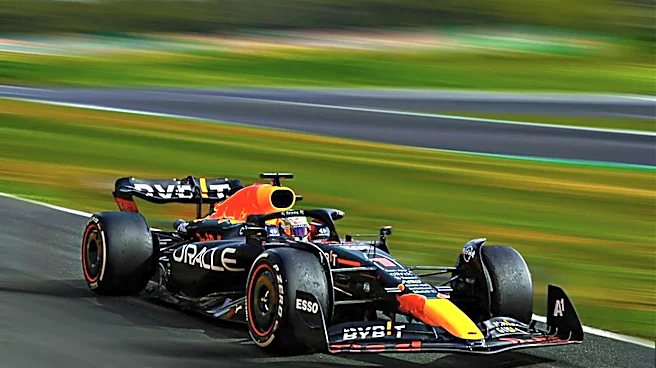
Max Verstappen, a driver for the Red Bull Ford F1 team, has expressed skepticism regarding the FIA's assessment that Red Bull-Ford Powertrains possesses a benchmark internal combustion engine (ICE) in Formula 1. The FIA's Additional Development and Upgrade
Opportunities (ADUO) assessments have indicated that Red Bull's ICE is superior, with Mercedes measured at a two to four percent power deficit, and other manufacturers like Ferrari, Audi, and Honda falling even further behind. This gap has allowed the trailing manufacturers to implement upgrades. However, Verstappen downplays the significance of this finding, stating that the team still needs to 'do a better job.' He echoes the team's formal contestation of the FIA's conclusions earlier this year, where team boss Laurent Mekies claimed Red Bull's telemetry showed no such advantage. The ADUO framework specifically evaluates only the combustion engine, not the total hybrid output of the power unit.
Why It's Important?
Verstappen's comments highlight a critical aspect of Formula 1's technical regulations and the competitive landscape. The FIA's ADUO system is designed to level the playing field by allowing less powerful engine manufacturers to develop their units, theoretically preventing one team from dominating due to a superior power unit. If Red Bull's perceived advantage is indeed overstated, as Verstappen suggests, it implies that the current regulatory framework might not be accurately reflecting the true performance disparities or that other components of the power unit and chassis are equally, if not more, critical to overall performance. This could influence future regulatory adjustments, potentially shifting focus from solely ICE performance to a more holistic evaluation of power unit efficiency and car design. For rival teams, this situation presents both a challenge and an opportunity: a challenge to catch up if Red Bull truly has an advantage, and an opportunity to exploit other areas of car development if the ICE gap is not as decisive as the FIA's assessment suggests.
What's Next?
The ongoing debate surrounding Red Bull's engine performance is likely to continue influencing technical discussions within Formula 1. While the FIA's ADUO assessments provide a quantitative measure, the practical application and interpretation of these findings by teams like Red Bull suggest a more nuanced reality. Future developments could involve further scrutiny of the ADUO framework itself, potentially leading to refinements in how engine performance is measured and how upgrade allowances are granted. Teams will continue to push the boundaries of development across all aspects of their cars, not just the ICE, to gain a competitive edge. The focus will remain on optimizing the entire power unit and chassis package, as even a perceived advantage in one area may not translate to overall dominance if other components are lacking. This ongoing technical arms race will shape the competitive dynamics of upcoming F1 seasons.
Beyond the Headlines
This situation delves into the complex interplay between regulation, innovation, and competitive strategy in Formula 1. The FIA's efforts to create a more balanced sport through regulations like ADUO are constantly met with teams' ingenuity in finding performance advantages within those rules. Verstappen's remarks underscore that raw engine power, while crucial, is only one piece of the puzzle. Aerodynamics, chassis design, driver skill, and operational efficiency all contribute significantly to a car's overall performance. This highlights a broader philosophical challenge in sports governance: how to foster competition and prevent monopolies without stifling innovation. The continuous back-and-forth between regulators and teams often leads to advancements that benefit the sport as a whole, pushing technological boundaries and creating more exciting racing. It also raises questions about the transparency and comprehensiveness of performance metrics used by governing bodies.